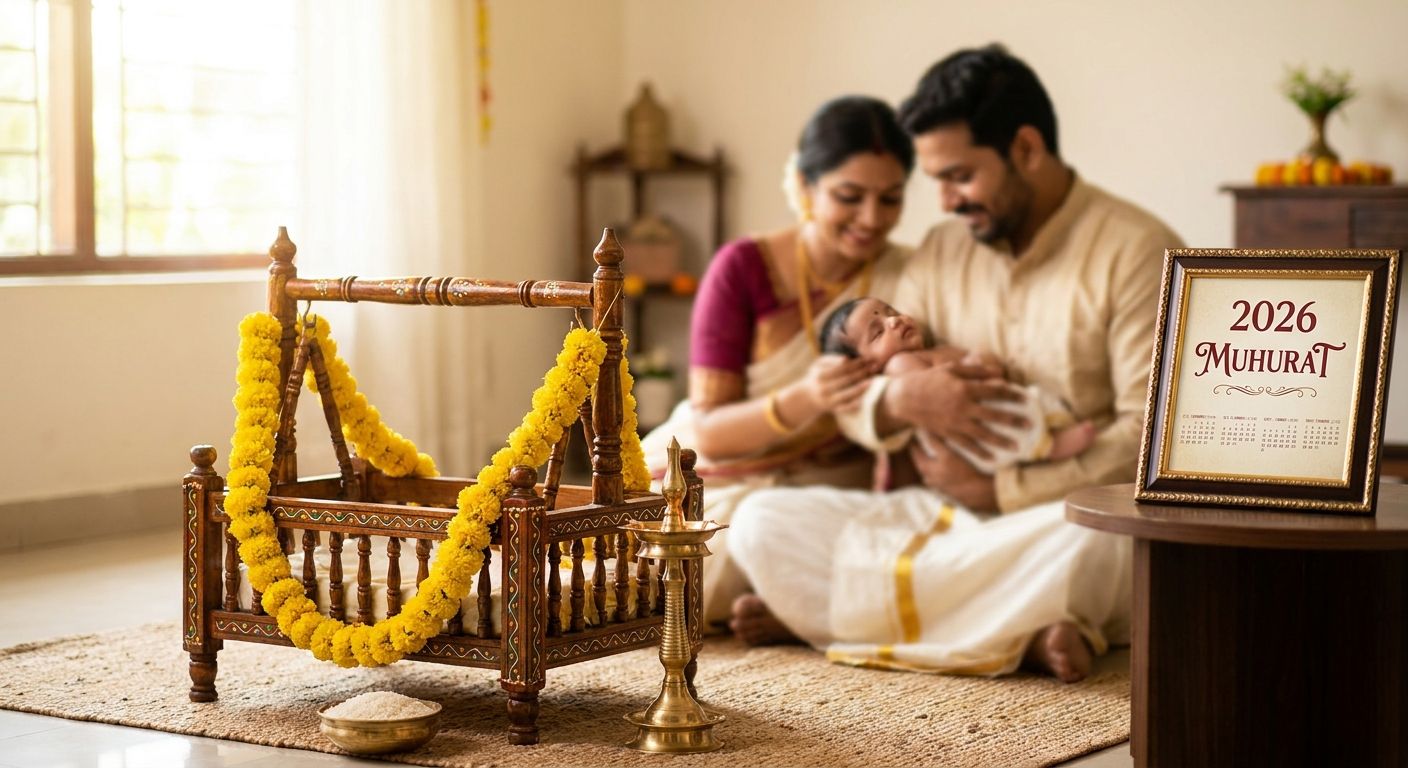
One date cannot be called the best naming ceremony muhurat for every family in 2026. Panchang factors change by place and clock time, while the baby's janma nakshatra comes from the recorded birth details. Family custom decides when namkaran may be held; the panchang helps compare the dates that are actually possible. If the parent or baby needs medical care or more recovery time, that comes first.
TL;DR
- There is no single naming ceremony muhurat that suits every baby or every city in 2026.
- Start with dates allowed by your family custom and the parent's and baby's practical needs.
- Check the local tithi, nakshatra and daily time periods for the place where the ceremony will happen.
- If the recorded birth time is uncertain, don't guess. Mark it as approximate because the birth star can change near a boundary.
Why a universal 2026 date list falls short
A list of "auspicious dates" leaves out the ceremony city, the intended start time and the family's ritual practice. Tithi and nakshatra can change during a civil calendar date, while Rahu Kalam and other daily periods are calculated from local sunrise and sunset. A date copied for Delhi may show different clock boundaries in Chennai, London or New York.
That does not make a general list useless. It can produce a first set of possibilities, but each possibility still needs a location-specific check. The Wishastro panchang is the right place to inspect the day itself; the muhurat guide explains how a chosen time differs from a broad calendar label.
Begin with the family's real date range
Namkaran customs vary by family, community and priestly tradition. Some families hold the rite soon after the period of post-birth observance, while others combine it with a later gathering. Treat the family's practice as the starting boundary instead of assuming that the 11th, 12th or 16th day applies everywhere.
Before checking the panchang, write down:
- The baby's recorded birth date, time and birthplace, with any uncertainty noted.
- The city where the ceremony will take place and the proposed start time.
- The dates permitted by the family's ritual custom.
- Medical, recovery, travel and venue limits that cannot be moved safely.
This order prevents a tidy calendar result from turning into an impractical plan.
What the panchang factors mean
Tithi and nakshatra
Tithi is the lunar-day division in effect at a given time. Nakshatra is the Moon's position within one of 27 lunar sectors. Both can change partway through a calendar date, which is why a useful muhurat gives a start and end time rather than naming the day alone.
Practitioners do not all apply the same shortlist of favorable tithis and nakshatras to namkaran. If a calendar rejects a date, ask which rule it used and whether that rule belongs to your family's tradition.
Vara, yoga and karana
Vara means weekday. Yoga and karana are two other panchang divisions used in many muhurat methods. Their presence on a screen does not create a verdict by itself; a priest or astrologer weighs them with the ceremony and local custom in mind.
Rahu Kalam, Bhadra and Panchak
Rahu Kalam divides the daylight period according to the weekday, so its length and exact clock time vary with local sunrise and sunset. Many families avoid beginning a ceremony within it. Bhadra and Panchak are also screened in some practices, but the restrictions attached to them vary by region and by activity. They should not be presented as universal vetoes.
How the baby's birth star fits in
Janma nakshatra means the lunar sector occupied by the Moon at birth. Some naming systems use its pada, or quarter, to suggest opening syllables. The nakshatra finder can calculate that result from the birth details.
A rounded birth time is often adequate when the Moon stayed in one nakshatra for the surrounding hours. Near a transition, however, a small time difference can change the nakshatra or pada. Keep an approximate time marked as approximate; don't choose whichever result gives the preferred syllable.
Three ways to compare possible dates
Method | What it can do | What it cannot do |
|---|---|---|
Family priest or customary calendar | Applies the ritual rules your family follows | May still need the exact city and start time |
Local panchang | Shows time-bound tithi, nakshatra and daily periods | Does not know the baby's birth chart or family practice |
Personal consultation | Compares a practical shortlist with the birth details | Cannot replace medical needs or settle family custom |
A sensible order for choosing
- Set the safe, workable date range with the family first.
- Check each candidate for the ceremony city, not a default city saved in an app.
- Compare exact time windows because panchang factors may change during the day.
- Confirm what the officiating priest needs for the ritual.
- Put the agreed city, time zone and start time on the invitation.
Astrology here is for guidance and reflection. It is not a substitute for medical advice, and it should never delay care or recovery for the baby or parent.
Compare the dates your family can use
Share the baby's recorded birth details, ceremony location and practical date range with an astrologer.
What commonly causes confusion
- Treating a civil date as one unchanging panchang day. A tithi or nakshatra can end before the ceremony begins.
- Using a fixed Rahu Kalam chart. The segment follows local daylight, so the clock time must be calculated for the date and place.
- Guessing a birth time. A false minute makes the chart look more certain than the record allows.
- Letting a generic rule overrule the family's practice. Namkaran customs are not identical across households.
Before you send invitations
Record the ceremony city, local start time, time zone and the source of the baby's birth time. Then ask the priest or astrologer to explain any rejected window in plain language. A useful muhurat decision should show its assumptions, not hide them behind a single green label.