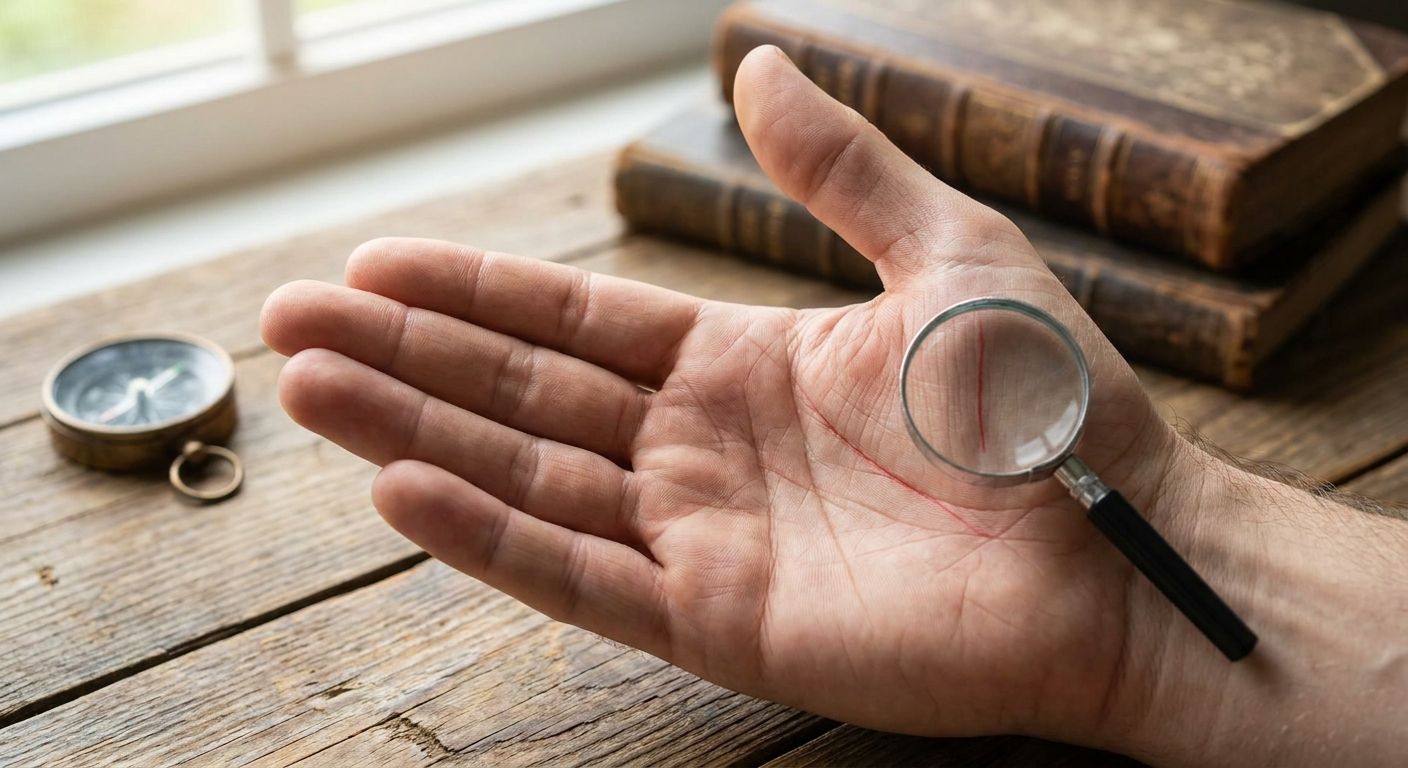
A health line palmistry reading traces the faint diagonal running from near the base of the thumb up toward the little finger, and it's read for how your body holds up under strain, not for what's actually wrong with it. Palmists in 2026 still use the same landmarks their teachers used decades ago: depth, breaks, chains and whether the line shows up at all.
TL;DR
- A health line palmistry reading looks at depth, breaks, chains and islands, not diseases or diagnoses.
- No health line at all is common and is usually read as a favorable sign, not a warning.
- A chained health line points to digestive or nervous sensitivity that shows up under stress.
- An island on the line marks a vulnerable stretch of time, and it closes once the line clears again.
- Classical Vedic Hast Rekha Shastra treats this line as secondary to the life, head and heart lines.
Why this matters
Most people who search for this are anxious about something specific: a faint line, a broken one, or none at all. That anxiety is understandable but misplaced, because palmistry was never built to replace a doctor's chart; it reads tendencies in constitution and stress response, the way a horoscope reads tendencies in temperament.
The honest starting point is this: the health line is one of the least standardized lines on the palm. Western chiromancy calls it the Mercury line or the Line of Health; classical Vedic palmistry, known as Hast Rekha Shastra, gives far more weight to the life line, head line, heart line and fate line, and treats the health line as a late, secondary addition rather than one of the core four. That difference in emphasis explains a lot of the conflicting answers you'll find searching this topic.
How to read your health line in palmistry
Work from your dominant hand for how you currently operate, and your non-dominant hand for inherited tendency, then check both against these seven points.
- Locate the line first. It usually starts near the mount of Venus at the base of the thumb and runs diagonally across the palm toward the mount of Mercury under the little finger. Not every palm has a visible one, and that's worth noting before anything else.
- Check whether it exists at all. Its absence is common and, in most readings, is treated as neutral to favorable, since a palm crowded with lines is often read as a busier, more anxious constitution.
- Assess depth and clarity. A deep, clean, unbroken line is read as steady physical resilience; a faint, wavering one suggests a constitution more sensitive to stress and lifestyle swings.
- Look for chain patterns. A section that looks like small linked loops, rather than one clean stroke, gets read as sensitivity around digestion or the nervous system, particularly during high-stress periods.
- Note any islands. A small oval break in the line marks a specific vulnerable stretch; once the line runs clear again past it, that stretch is read as having passed.
- Check for clean breaks. A gap with no island, where the line simply restarts a little further along, is read as a sudden disruption followed by recovery, not a permanent mark.
- Cross-reference with the head and life lines. Where the health line crosses or touches these, palmists read it as a compounding factor, for better or worse, rather than reading it alone.
No health line: what it means
A palm with no visible health line at all is not a gap in the reading; it's arguably the most common outcome, and most palmists read it as favorable. The absence suggests fewer worries manifesting physically, since this line is thought to appear in response to stress and constitutional sensitivity rather than existing by default. If your palm is otherwise clean, this is one of the better outcomes you can get from this particular line.
Chained health line: what it means
A chained or braided section along the health line is read as recurring sensitivity, most often tied to digestion, sleep or the nervous system, especially during stretches of pressure at work or at home. It doesn't predict a specific illness. It flags a pattern worth managing rather than ignoring, particularly if the chaining sits close to where the line crosses the head line.
Broken health line: what it means
A clean break, where the line stops and picks up again slightly offset, is read as a sudden disruption rather than a chronic weakness. Palmists generally read the resumption of the line past the break as the more important detail: it suggests recovery follows the disruption rather than the disruption becoming permanent.
Straight, deep, unbroken health line: what it means
This is treated as the strongest possible reading for physical resilience and steady energy, and it's genuinely rare compared to the chained or absent versions. Even here, palmists caution against reading it as immunity from anything; it's a tendency toward faster recovery and steadier stamina, not a guarantee.
Forked health line at the top: what it means
A fork near where the line ends, close to the little finger, is sometimes read alongside adaptability under physical stress, meaning the person tends to recover in more than one way when their routine is disrupted. It's a minor variant, and most palmists weigh it far less heavily than chaining or islands lower on the line.
“A blank patch of skin where the health line should be is not proof of good health; it is proof that palmistry doesn't track lab results.”
Why health line readings vary so much
Ask five palmists to read the same hand and you'll likely get five slightly different answers on this particular line, more so than on the life or head line. A few real reasons drive that:
- Tradition gap. Vedic Hast Rekha Shastra treats the health line as secondary; Western chiromancy treats it as one of the standard set, so weight given to it differs by school.
- Hand choice. Reading the dominant versus non-dominant hand changes the emphasis between current lifestyle and inherited constitution.
- Print clarity. A photograph or ink print taken in poor light flattens depth cues that a live reading under angled light picks up easily.
- Age of the palm. Skin creases shift over decades, so a reading done at 20 and again at 50 can genuinely differ, not because the palmist is inconsistent.
- Interaction with other lines. A health line crossing a strong head line gets read differently than the same health line crossing a weak or broken one.
Is having no health line in palmistry bad?
No, having no health line is usually read as a favorable sign, not a bad one; most palmists treat its absence as an indicator of fewer stress-related physical patterns rather than a missing piece of information. It's one of the more reassuring outcomes in this specific reading, and it's also one of the most common.
Does the health line predict real illness?
No, the health line does not predict a specific illness or medical diagnosis; it's read as a tendency toward physical resilience or sensitivity under stress. Anyone reading a serious health concern into a palm line rather than a doctor's exam is misusing the tradition, not applying it.
Which hand should you read for the health line?
Most palmists read the dominant hand for how the constitution currently operates and the non-dominant hand for what's read as inherited tendency. Comparing both hands side by side is standard practice, since a line that's chained on one hand and clear on the other tells its own story about how lifestyle has shifted things.
If you'd rather have someone walk the whole palm with you rather than piece it together from an article, you can talk to an astrologer online and ask them to look at the health line alongside the rest of the hand, since lines rarely mean much read in total isolation.
Get your palm read properly
Ask an astrologer to walk your full palm, not just one line.
One last thing
The health line isn't one of the four classical lines in Hast Rekha Shastra at all; it's a Western import that got folded into modern Indian palmistry practice over the last century, alongside the life, head, heart and fate lines that the older texts actually built their systems around. That's worth remembering the next time a reading leans hard on this one line: it carries less traditional weight than the life or head line, even where it looks the most dramatic on the palm.
This article is for guidance and reflection. It is not a substitute for medical advice, diagnosis, or treatment.