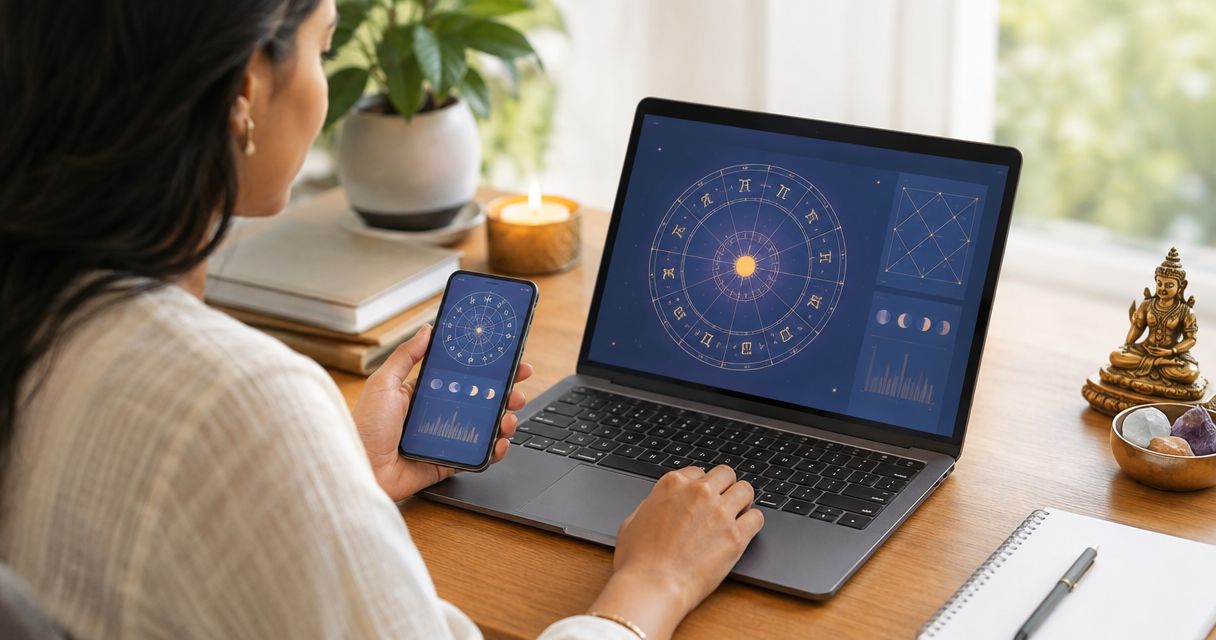
Prokerala brings kundli (your birth chart) and panchang (the Hindu calendar used for daily timing) calculations together, which suits readers who want both in one place. That breadth stops being enough when your next question needs either a personal chart explanation or a closer look at local calendar timings. The best Prokerala alternative in 2026 is Wishastro if you need personal kundli tools; Drik Panchang if you need location-specific panchang information.
TL;DR
- Among Prokerala alternatives, Wishastro suits personal kundli exploration rather than replacing every calendar function.
- Drik Panchang is the stronger fit for panchang, festival dates and local daily timings.
- AstroSage belongs on your shortlist when your main task is generating and examining a Vedic kundli.
- Compare birth details and ayanamsa before treating different chart results as a calculation error.
Prokerala alternatives: why your task matters
A birth chart and a daily calendar answer different questions. Your kundli uses your birth details; a panchang uses the date and location you're checking. A site that's useful for marriage matching isn't automatically the right choice for finding a local festival observance.
Start with the question you actually have. If you're trying to understand what the chart contains, the guide to reading your birth chart as a beginner is a better next step than generating another unexplained chart.
This comparison uses Vedic, sidereal astrology as its reference. Sidereal calculations measure positions against a zodiac tied to the stars; ayanamsa (the gap between sidereal and tropical zodiacs) sets the adjustment. Lahiri ayanamsa is the reference here, although any tool's actual settings still need checking.
Choose the tool that answers your question, not the one that produces the longest report. A page full of chart labels can still leave you unable to explain why a conclusion follows.
Alternatives at a glance
Prokerala: best for keeping chart and calendar tasks together
Prokerala is the benchmark if you already use both its astrology calculators and panchang information. Staying makes sense when those outputs answer your questions and you understand the settings behind them.
Its broad coverage doesn't remove the need to separate calculation from interpretation. A chart position, a matching result and a calendar timing aren't interchangeable forms of advice.
Wishastro: best for personal kundli exploration
Wishastro offers tools for kundli, matching, dosha (a configuration traditionally read as a difficulty), dasha (a planetary period) and related chart questions. Its role in this shortlist is personal astrology exploration, rather than a claim that it replaces every Prokerala calendar function.
Best for: You want to explore a chart question independently before deciding whether it needs a personal explanation.
Drik Panchang: best for calendar-first questions
Drik Panchang focuses on Hindu calendar information, including panchang and festival dates. It's the more direct alternative when your question concerns a day and place rather than the meaning of your birth chart.
Best for: You need local daily timings or want to understand when a calendar observance falls.
AstroSage: best for chart-first questions
AstroSage offers Vedic kundli calculation and chart reports. It belongs in a chart-focused comparison, rather than being treated as the default replacement for every panchang task.
Best for: You want to generate a Vedic chart and examine its components, while keeping interpretation separate from the calculation itself.
1. Wishastro: best for exploring personal chart questions
Wishastro is a useful kundli alternative when your starting point is a personal question about relationships, career or family. You can explore its astrology tools independently; running a tool needs no sign-up, and the result is saved to a private link. Saving a result to an account is a separate step that needs sign-up.
That distinction matters. No sign-up doesn't mean nothing is saved, and a saved result doesn't mean you've received a complete interpretation of your circumstances.
Where it shines
- The tool range covers several connected chart tasks, including kundli, matching, dasha and nakshatra (a lunar mansion).
- You can start with an independent calculation rather than making a consultation your first step.
A useful sequence is to establish the birth chart before exploring a narrower result. A dosha label without its chart context invites an overreaction; a dasha period without the planet's condition in the kundli is also an incomplete reading.
Where it falls short
- A personal chart result shouldn't be treated as a substitute for a location-specific panchang.
- A tool result doesn't settle a marriage, health or financial decision, even when its wording sounds definite.
Wishastro also offers paid one-to-one chat with an astrologer if you want personal guidance, but a consultation is a separate choice from running a tool.
Head-to-head with Prokerala
For personal chart exploration, both belong in your comparison; the useful distinction is which result you can understand and follow up. For daily calendar work, this recommendation doesn't establish a replacement for Prokerala's panchang coverage. For birth-data accuracy, neither service can turn an uncertain birth time into a confirmed one merely by producing a chart.
Best for: Personal kundli exploration in 2026, especially when you want to separate a calculation from a later discussion. Verdict: Hold the result as a starting point, not a final instruction.
2. Drik Panchang: best for location-specific calendar work
Drik Panchang is the better-directed alternative when you need a panchang rather than another personality reading. Its calendar focus matches questions about tithi (the lunar day), festival observance and local timing. Your location belongs in that question because sunrise and local clock times change with place.
A birth-chart site can be useful and still be the wrong first stop for checking a ceremony's calendar context. In 2026, that distinction remains more useful than choosing a service because it appears on a longer alternatives list.
Where Drik Panchang shines
- Its calendar focus suits questions about daily panchang and festival dates.
- Location-based information helps you avoid treating a timing from another city as your local answer.
Where Drik Panchang falls short
- A favourable calendar period isn't a promise that the event will succeed.
- A daily panchang doesn't explain your personal dasha or replace a birth-chart reading.
Head-to-head with Prokerala
For calendar questions, both are relevant; Drik Panchang is the calendar-first choice in this shortlist. For local timing, compare the selected city and date before comparing the displayed answers. For personal interpretation, a panchang entry alone isn't enough on either service.
Best for: Local calendar checks and festival questions. Verdict: Hold the timing until you've confirmed the place, date and observance you mean.
3. AstroSage: best for generating a Vedic kundli
AstroSage is a chart-first alternative for readers who want a Vedic kundli and its associated reports. It's a reasonable shortlist entry when you're examining chart structure rather than choosing a festival date.
Where AstroSage shines
Its kundli tools suit a birth-chart task. That makes it easier to keep your comparison centred on the same birth details and the same kind of output.
Where AstroSage falls short
A report can't correct a guessed birth time. More chart material also doesn't establish that every written prediction applies to you or that the underlying interpretation is proven.
Head-to-head with Prokerala
For kundli generation, compare identical birth inputs. For chart differences, compare ayanamsa and calculation settings before comparing predictions. For calendar use, don't assume a chart recommendation answers your panchang question too.
Best for: Examining a Vedic birth chart in 2026. Verdict: Hold predictions until you understand the chart factors used to support them.
What a kundli comparison should actually check
The chart's appearance is a poor test of agreement. North Indian and South Indian chart layouts organise the drawing differently; a different-looking diagram doesn't by itself mean the planetary calculation changed.
Birth details
Use the same recorded date, time and birthplace for each calculation. Time-zone handling belongs here too, especially for historical births where the local civil-time rules need attention.
If the time is uncertain, keep that uncertainty visible. Lagna (the ascendant, or zodiac degree rising on the eastern horizon) depends on time and place, so a guessed time weakens house-based conclusions. A polished report doesn't repair that weakness.
Zodiac settings
A sidereal result and a tropical result aren't a like-for-like comparison. Check the zodiac first, then the ayanamsa used for a sidereal chart; two different settings can explain a difference without either calculator being broken.
The zodiac has 12 signs, each spanning 30 degrees. These are calculation divisions, not evidence that a person's future follows a report's wording.
Reading logic
A credible explanation connects its conclusion to named chart factors. If a marriage reading mentions Mars, it should explain the relevant placement and the tradition's qualifying conditions, rather than announcing a dosha as an unavoidable outcome.
The same applies to dasha. A planetary period isn't a dated promise of promotion, divorce or profit; Vedic interpretation reads it alongside the planet's role and condition in the birth chart.
What a panchang comparison should actually check
A panchang has five traditional components: tithi, vara (weekday), nakshatra, yoga (a division based on the combined solar and lunar longitudes) and karana (half a tithi). Checking only a date label leaves most of the method unseen.
Tithi advances with each 12 degrees of angular separation between the Sun and Moon. Because that separation doesn't follow midnight boundaries, a lunar day can begin or end during a civil day.
Nakshatra uses 27 divisions of the zodiac, each spanning 13 degrees and 20 arcminutes. That structure explains why an exact boundary matters; it doesn't justify pretending to know a current lunar position without calculating it.
For a useful comparison, match the city and date, then identify what each time describes. A tithi ending time isn't the same thing as a recommended ceremony window, and a festival assigned by a sunrise rule needn't follow the date you expected from a midnight-based calendar.
Why people switch from Prokerala
There isn't a reason to invent an outage, a price change or a privacy complaint to justify switching. The defensible reasons are task-specific.
You might want a chart-focused workflow because a general calculator leaves you with labels you can't interpret. You might instead need a calendar-first service because your question concerns local tithi or festival observance. Those are different needs, so they deserve different recommendations.
A third reason is wanting to understand a discrepancy. In that case, changing services before checking inputs often creates another result without resolving the first disagreement. For a 2026 comparison, matching settings is more useful than counting how many reports each site produces.
When staying with Prokerala is the right call
Stay with Prokerala if its kundli and panchang tools answer your actual questions and you can identify the settings used. Switching solely because another report sounds more flattering is a weak reason; reassurance isn't a calculation method.
For calendar work, the useful standard is whether you can understand the location, date and timing shown. For a kundli, it's whether the birth details and zodiac settings are clear. If those needs are already met, another service is an optional cross-check, not an automatic upgrade.
One last thing
The most useful cross-check isn't another prediction. It's whether two services agree after you've matched the birth details, location and calculation settings. If they still disagree, the disagreement is a question to investigate, not permission to choose whichever answer you prefer.