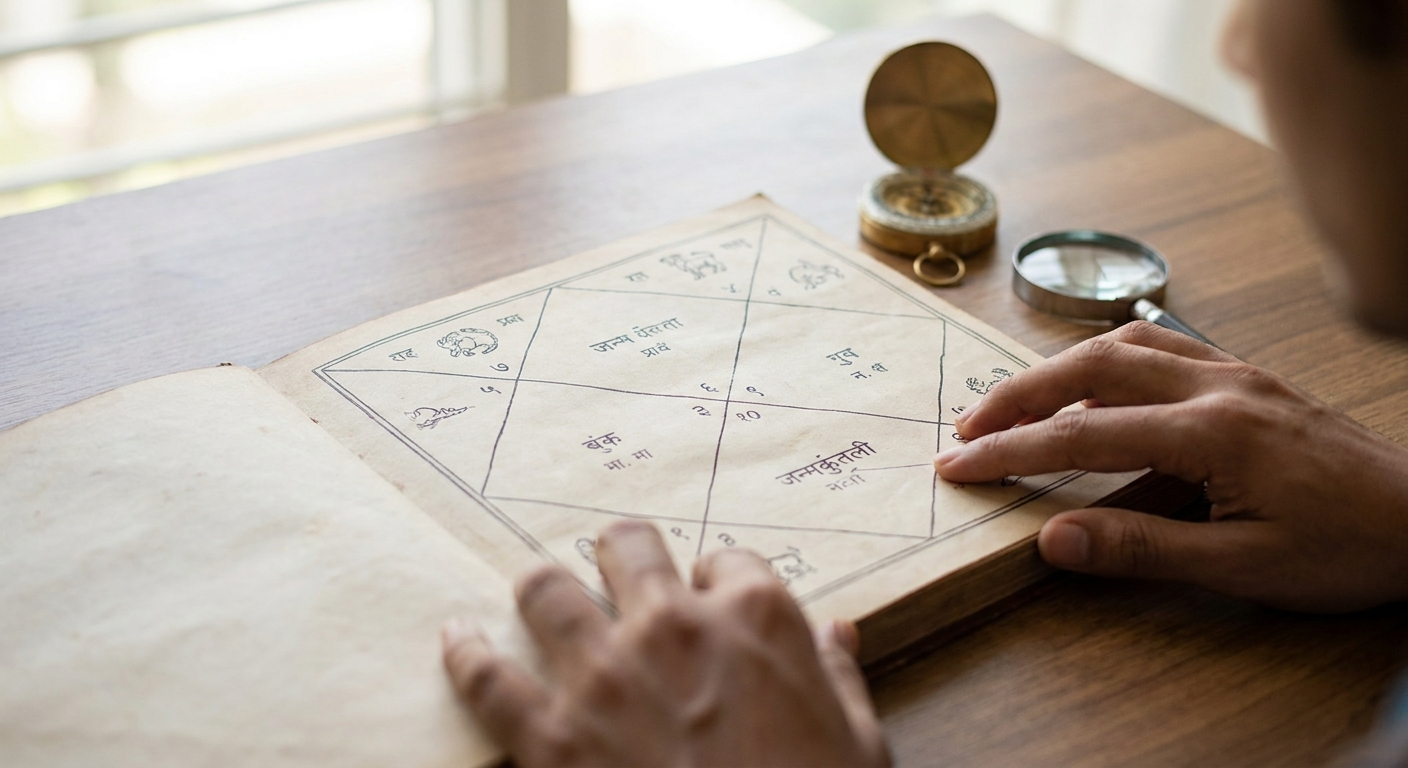
Reading your dasha periods tells you which planet is running your life right now, and for how long, so you can stop guessing why certain years feel heavy and others feel lucky. This guide breaks down the Vimshottari Dasha system step by step, using your own kundli, no jargon left unexplained.
TL;DR
- Vimshottari Dasha splits a 120-year life cycle across 9 planets, each with a fixed Mahadasha length.
- Your Moon's nakshatra at birth decides which dasha you start with, not your Sun sign.
- Saturn's Mahadasha runs 19 years and Venus runs 20 years, the two longest periods most people will experience.
- Antardasha and Pratyantardasha sub-periods narrow the timing down to months, not just years.
- Reading dasha periods correctly needs an exact birth time, an approximate time throws off the whole sequence.
Why this matters
Most people check their kundli once, see a scary-looking dasha name like Rahu or Saturn, and panic. That reaction skips the actual mechanics.
Dasha timing is what turns a static birth chart into a moving timeline. A planet sitting well-placed in your chart can still give tough results if it rules a period when it's weak, and a so-called "malefic" dasha can bring career growth if the planet is strong by house and sign. Learning to read the sequence yourself means you stop outsourcing every life decision to someone else's interpretation of a chart you've never fully looked at.
Wishastro's free birth chart and kundli tools show your dasha breakdown automatically, so this guide focuses on what those numbers actually mean once you're looking at them.
What you'll need
- Your exact birth time, down to the minute if possible (a 15-minute error can shift nakshatra boundaries)
- Birth date, birth place, and time zone at birth
- A generated kundli or birth chart showing the Vimshottari Dasha table
- 20-30 minutes, uninterrupted, the first time you do this
- Optional: a notebook to track which Antardasha you're currently in
If you don't have your dasha table yet, generate one through a free kundli calculator before starting step one below.
The steps
1. Find your Moon's nakshatra at birth
Your Mahadasha sequence doesn't start from your Sun sign or your age, it starts from the nakshatra your Moon occupied the moment you were born. There are 27 nakshatras, and each one is ruled by one of the 9 dasha planets.
Open your kundli and locate the "Moon Nakshatra" field. That single data point decides your entire starting dasha lord, so get this step right before moving on.
Common mistake: confusing Moon sign (rashi) with Moon nakshatra. They're different systems layered on the same zodiac.
2. Locate your Mahadasha lord and start date
Every kundli with a dasha table lists 9 Mahadasha blocks in sequence, each with a start and end date. Find the block you're currently inside, that planet is your active Mahadasha lord.
The fixed Vimshottari lengths are: Ketu 7 years, Venus 20 years, Sun 6 years, Moon 10 years, Mars 7 years, Rahu 18 years, Jupiter 16 years, Saturn 19 years, Mercury 17 years. These nine add up to 120 years, the full Vimshottari cycle.
3. Check your dasha balance at birth
Nobody is born exactly at the start of a fresh Mahadasha. Your kundli shows a "balance of dasha" figure, the leftover years, months, and days of your first Mahadasha that were already used up before birth based on your Moon's exact degree in its nakshatra.
This balance is why two people born on the same day can be running completely different dashas by age 30. A baby born with 2 years of Jupiter dasha balance remaining hits their second Mahadasha far sooner than one born with 14 years remaining.
4. Break the Mahadasha into Antardasha periods
Each Mahadasha is divided into 9 Antardasha (sub-period) blocks, one for every planet, in a fixed sequence starting with the Mahadasha lord itself. So a Saturn Mahadasha opens with a Saturn-Saturn Antardasha, then moves to Saturn-Mercury, Saturn-Ketu, and onward.
The length of each Antardasha is proportional: a Saturn Mahadasha's Venus Antardasha lasts roughly 3 years and 2 months, calculated as a fraction of Saturn's 19-year total. This is where dasha reading gets genuinely useful, because Antardasha shifts explain why a single Mahadasha can feel like five different chapters.
5. Narrow down with Pratyantardasha
If you need month-level precision, go one layer deeper into Pratyantardasha, the sub-sub-period inside each Antardasha. Serious predictive work, the kind astrologers do in paid consultations, almost always operates at this level rather than the broad Mahadasha.
Most free kundli tools show at least two levels (Mahadasha and Antardasha); Pratyantardasha detail is where a live reading with an astrologer adds real value over a static chart.
6. Match the dasha lord's placement to a life area
A dasha isn't generic, it activates the house and sign the ruling planet sits in, plus the houses it owns. Mercury running your 7th house lord's Mahadasha leans toward partnership and marriage themes; Mercury running your 10th house lord leans toward career and public reputation.
Look at which houses your current Mahadasha lord owns and occupies before assuming what the period is "about."
7. Cross-check with current transits
Dasha sets the theme, transits set the timing of specific events inside that theme. A Jupiter Mahadasha combined with Jupiter transiting your 1st house in 2026 is a stronger growth signal than Jupiter Mahadasha alone with no supporting transit.
Common mistake: reading dasha in isolation and ignoring what's transiting overhead right now.
8. Track the dasha lord's own strength
A planet's Mahadasha result depends heavily on whether that planet is exalted, debilitated, combust, or in its own sign in your birth chart. A debilitated Mars running its own Mahadasha behaves very differently from an exalted Mars running the same period length.
This is the step most beginners skip entirely, and it's the single biggest reason two people with the "same" dasha report opposite experiences.
Get your dasha explained live
Talk to an astrologer about your current Mahadasha and Antardasha, free to start.
Troubleshooting
My kundli shows a different dasha lord than my friend's tool. Birth time entered with even a 10-15 minute gap can push your Moon into a neighboring nakshatra, changing the entire sequence. Re-check the birth time source, hospital records are more reliable than family memory.
I don't know my exact birth time. Dasha calculation without an accurate time is unreliable past the Mahadasha level; Antardasha and Pratyantardasha need precision. Get the closest estimate available and treat results as directional, not exact.
My current dasha is supposed to be "bad" but life feels fine. Dasha results depend on the planet's placement and strength in your specific chart, a textbook description of "Rahu Mahadasha problems" doesn't apply uniformly to everyone.
I can't tell where one Antardasha ends and the next begins. Antardasha boundaries are usually listed as exact dates in a proper dasha table, if your tool only shows the Mahadasha, you need a more detailed chart output.
Two dasha calculators gave me different balance-of-dasha figures. This usually traces back to different ayanamsa settings (Lahiri vs Raman, for example). Stick to one calculation method consistently rather than comparing across tools.
I want to know if my dasha lines up with a specific event date. That level of timing needs Pratyantardasha plus transit analysis together, which is exactly the kind of cross-check a live consultation covers better than a static reading.
Tools and resources
- A free kundli generator that outputs your full Vimshottari Dasha table with Mahadasha and Antardasha dates
- The kundli matching guide if you're comparing two charts for compatibility alongside dasha timing
- A notebook or spreadsheet to log your current Mahadasha, Antardasha, and the transit dates you want to track through 2026
- A live astrologer session for Pratyantardasha-level detail your free tool doesn't break down
What to do next
Once you know your current Mahadasha and Antardasha, the next useful step is checking how those periods interact with your daily and weekly transits rather than reading them as a fixed forecast. If you want someone to walk through your specific Antardasha sequence with you, you can talk to an astrologer online for free before deciding on a full paid consultation.
One last thing
The Antardasha sequence inside every Mahadasha always starts with the Mahadasha lord itself before cycling through the other 8 planets, so the opening months of any new Mahadasha tend to feel like an intensified preview of that planet's themes. If your Saturn Mahadasha just began in 2026, the first Saturn-Saturn Antardasha, lasting a little over 3 years, is the truest test of what the next 19 years will actually feel like.