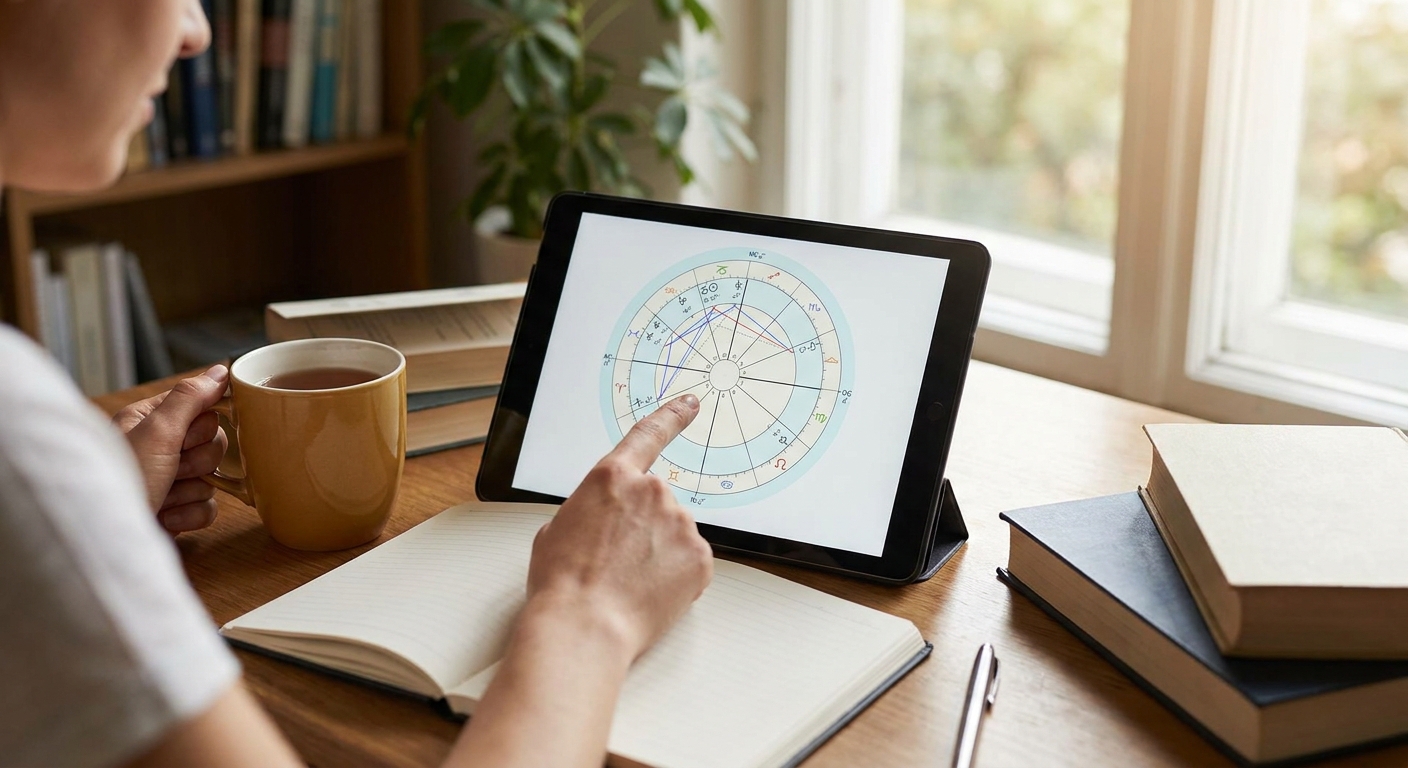
Reading a birth chart looks like decoding a wheel full of symbols the first time you open one, but the whole thing breaks down into five things: your Sun, your Moon, your Ascendant, ten planets, and twelve houses. Once you know where to look, a 2026 birth chart reading takes about 15 minutes with a free tool and this guide.
TL;DR
- Start with the Big 3 -- Sun, Moon, Ascendant -- before touching the other eight planets.
- Birth time accuracy matters: a 4-minute error can shift your Ascendant by roughly 1 degree.
- Vedic and Western charts can show different signs for the same person because of a 23-24 degree ayanamsa gap.
- Wishastro's free birth chart tool generates a full Vedic and Western reading without signup.
- Empty houses are not a problem -- check the house ruler instead of assuming nothing is happening there.
Why this matters
Most people quit halfway through a birth chart because they try to read all twelve houses and ten planets at once. That is backwards. A chart is a layered document, and in 2026 the free calculators available online (including Wishastro's) generate the full chart instantly, but interpreting it still takes a sequence. Skip the sequence and you end up staring at glyphs that mean nothing. Follow it and the chart starts reading like a paragraph about your personality, timing, and patterns.
What you'll need
- Your exact date of birth
- Your exact time of birth, to the minute if possible (check your birth certificate or ask a parent)
- Your place of birth (city is usually enough, but exact hospital helps for rectification later)
- A free birth chart generator -- Wishastro's homepage has one that produces both Vedic and Western readings without any signup
- 15-20 minutes of uninterrupted time for your first read
- Optional: a notebook to jot down your planet-house placements as you go
The steps
1. Enter your birth details and generate the chart
Accuracy here decides everything downstream. A birth time off by even 4 minutes can shift your Ascendant degree, and in some cases it moves you into an entirely different rising sign. If your parents only remember "early morning" or "around noon," use that as a placeholder but flag your Ascendant as unconfirmed until you can verify it. Most free tools, including the one on Wishastro, ask for city-level location, which is precise enough for planet positions but not always for house cusps.
Common mistake: entering a rounded time like 6:00 AM when the real time was 6:47 AM. That 47-minute gap can move your Ascendant by more than 11 degrees.
2. Identify your Big 3 first
Your Sun sign is your core identity, your Moon sign is your emotional wiring, and your Ascendant (Lagna in Vedic astrology) is how you come across to others in the first few minutes of meeting them. These three alone explain most of what people expect from a full reading.
Don't move to the other eight planets until you can state your Big 3 in one sentence: "Sun in Leo, Moon in Cancer, Ascendant in Virgo" for example. That sentence is your anchor for every other placement.
3. Map the ten planets to their houses
A Vedic chart tracks nine grahas (the Navagraha, including the lunar nodes Rahu and Ketu), while a Western chart tracks ten planets including Uranus, Neptune, and Pluto. Each planet sits in one of twelve houses, and each house governs a specific life area: the 7th house covers marriage and partnerships, the 10th covers career, the 4th covers home and family.
Write down each planet next to its house number. This is the single most time-consuming step, but it's also the one that turns a chart from decoration into information.
4. Note any retrograde markers
A small "R" next to a planet means it's in apparent retrograde motion from Earth's point of view. It does not mean the planet is weaker or malefic by default, it means its themes tend to play out internally or get revisited later. Mercury retrograde happens 3-4 times a year and gets the most attention, but any planet can carry the marker.
5. Check the major aspects between planets
Conjunctions (planets within a few degrees of each other), oppositions (roughly 180 degrees apart), and trines (roughly 120 degrees apart) tell you how planets interact rather than sitting in isolation. A Sun-Moon conjunction, for instance, usually reads as someone whose public self and private self are closely aligned.
6. Cross-reference your nakshatra and any dosha
If you're reading a Vedic chart, your Moon's nakshatra (one of 27 lunar mansions) adds a finer layer of detail than the Moon sign alone. This is also where you'd check for a mangal dosha or check your current dasha period, since these show up as separate calculations from the basic planet-house map.
7. Confirm the pattern with a professional read
Self-reading gets you 70-80% of the way, but Ascendant rectification, dasha timing, and conflicting placements are easier to confirm with someone trained to spot them. If two placements in your chart seem to contradict each other, that's exactly the kind of thing worth a second opinion rather than guesswork.
Get a second opinion on your chart
Talk to an astrologer online and confirm what your birth chart is actually saying.
Explore free tools · Talk to an astrologer
Troubleshooting
"I don't know my exact birth time." Use noon as a placeholder and treat your Ascendant, house cusps, and Moon-to-house placements as unconfirmed. Your Sun sign and planet-to-sign placements stay accurate regardless of time.
"Two different sites gave me two different charts." This usually comes down to ayanamsa (the roughly 23-24 degree offset between Vedic sidereal and Western tropical zodiacs) or house system (Lahiri versus Placidus, for example). Pick one system and stick with it rather than comparing across tools.
"I have too many placements to track." Go back to the Big 3. Every other placement is a supporting detail, not a replacement for Sun, Moon, and Ascendant.
"My chart has empty houses." An empty house doesn't mean nothing happens in that life area. Look at the house's ruling planet and where that ruler sits instead.
"The dasha or dosha section is confusing." These are Vedic-specific calculations layered on top of the basic chart. If your birth time is unconfirmed, dasha timing especially will be unreliable, since dasha periods are calculated from your Moon's exact nakshatra degree.
"I got a different rising sign after fixing my birth time." That's expected. The Ascendant changes roughly every 2 hours as the earth rotates, so even small time corrections can shift it.
Tools and resources
- Wishastro's free birth chart tool for generating both Vedic and Western charts without signup
- How kundli matching works using just your date of birth if you're comparing two charts for compatibility
- A notebook or spreadsheet to log planet-house placements as you learn them
- Your birth certificate or a parent's memory for confirming exact birth time
What to do next
Once your chart is mapped, the next useful move is tracking how current planetary transits interact with your natal placements. Reading a Taurus weekly horoscope or an Aries weekly horoscope alongside your chart shows you how today's sky is activating houses you just identified, which is a faster way to see your chart actually mean something week to week rather than staying a static document from 2026.
One last thing
The detail beginners skip most often is the nakshatra, but it's the layer that explains why two people with the same Moon sign feel completely different. A Cancer Moon in the Pushya nakshatra reads differently than a Cancer Moon in Ashlesha, even though both fall in the same 30-degree sign. If your chart reading feels accurate but incomplete, the nakshatra is usually the missing 10%.