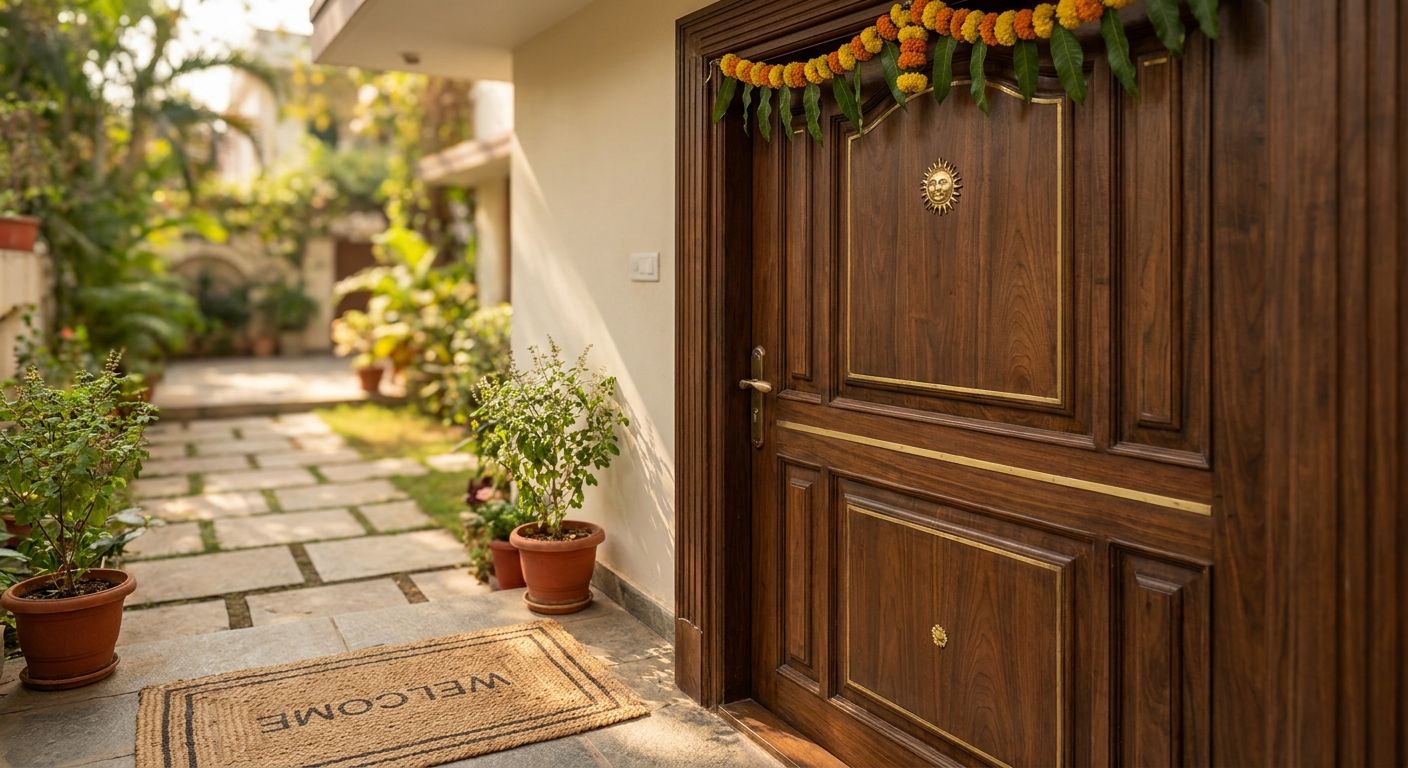
Vastu for main door questions almost always start the same way: someone has already bought the plot, or already built the house, and now wants to know if the entrance they've got is a problem worth fixing. In 2026, most of that answer comes down to three things: which compass direction the door faces, where it sits within that direction's wall, and how much correction a weak direction actually needs once you can't move it anymore.
TL;DR
- Vastu for main door favors north, east and northeast doors; south and southwest doors need active correction.
- A door's pada placement within its direction matters as much as the compass direction itself.
- Southwest main doors are the hardest to fix without structural change, so treat that direction as the real skip.
- Small remedies like a toran or a raised threshold shift a weak direction; they don't cancel a strong dosha.
Why this matters
Vastu Shastra treats the main door as the point where a house takes in its share of the outside world's movement, money and health, which is why it gets more attention than any other opening in the plan. A door isn't judged on its own: it's read against the compass, against the shape of the plot and, in a lot of Vedic households, against the birth details of whoever is moving in. If you've already worked out your own lagna, the rising sign that anchors a birth chart, using a tool like calculate your lagna without an exact birth time, the same directional logic will feel familiar: north, east and the northeast corner keep coming up as strong, while south and southwest carry weight that needs managing rather than ignoring.
Who this is for
This is for anyone with an actual door to deal with: a family finalizing a floor plan with an architect, someone comparing two flats where the only real difference is which way the entrance faces, or a homeowner who's lived with a south-facing door for years and wants to know if a threshold fix is worth doing before repainting in 2026. It's less useful if you're renting for a year and can't touch the structure at all, since most of the real correction options here involve the door itself and what sits just outside it, not the furniture around it.
What to look for in Vastu for a main door
1. Which compass direction the door actually faces
Get a compass reading, not a guess based on which way the street runs. North, east and northeast are the three directions Vastu tradition reads as strong for a main entrance, tied to Kubera (wealth), Indra (the rising sun) and Ishanya, the northeast corner ruled by Shiva. South and southwest are read as harder directions, not because they're unlucky in some vague sense, but because the ruling forces attached to them, Yama in the south and Nairutya in the southwest, are traditionally associated with heaviness and depletion rather than inflow.
2. Where the door sits within that direction's wall
Classical Vastu Purusha Mandala divides each side of a plot into eight padas, and the door's exact pada matters as much as the direction itself. A door in the northeast wall works best in the second or third pada counting away from the true corner, not right on the diagonal point, because the corner itself is read as too concentrated for daily traffic. The same logic holds on every wall: dead centre or right on a corner are both weaker positions than a pada slightly off from either.
3. What sits at the plot's centre, behind the door
A main door that opens straight into a load-bearing wall, a staircase going down, or a heavy structure blocking the Brahmasthan, the plot's open centre, undoes some of the benefit of a good direction. Vastu tradition treats the centre of a home as a space that should stay light and open, so a door that forces movement to bend hard right or left the moment you step in is working against the direction it's built on, not with it.
4. Door size, height and how many doors line up with it
The main door should be the largest door in the house, and classical texts favor a height to width ratio of roughly 2:1 rather than a square frame. A main door smaller than a bedroom door, or lined up directly with a back door so you can see straight through the house, is read as letting whatever comes in leave just as fast.
5. What's directly outside the threshold
A main door facing a T-junction, a transformer, a large tree trunk close to the frame or a neighbor's toilet wall is treated as picking up a dosha regardless of which direction it's in. The fix isn't always moving the door: a raised threshold called a dehleez, a toran hung across the top, or a Vastu pyramid placed near the frame are the remedies tradition prescribes for this specific problem, meant to soften the effect rather than erase a structural issue.
6. Building a house versus buying into one
An independent plot gives you control over the compass direction and the exact pada; a flat buyer only controls the door's position within the unit, not the building's orientation. If you're flat hunting, weigh the unit's entrance direction and, more usefully, check that the door doesn't open directly opposite a lift shaft, a stairwell going down, or another unit's toilet wall, since that layout dosha isn't affected by which floor you're on.
Top picks: which main door directions actually work
Four directions come up again and again in Vastu readings for a main entrance. Here's how each one plays out in 2026, with the pada detail that changes the verdict.
Northeast (Ishanya): the classic favorite
Ishanya is the direction most Vastu consultants default to first, ruled by Shiva and linked to water, clarity and spiritual weight. The strongest placement sits in the second or third pada moving away from the exact corner point, since the corner itself is considered too concentrated for everyday traffic. If your plot allows it, this direction rarely needs a remedy stacked on top of it. Favorable.
North: the wealth-zone pick
North is ruled by Kubera, the deity Vastu tradition ties to wealth and storage, which is why a lot of shop entrances and home offices favor it. A north door works best positioned in the middle third of the wall rather than tucked near either corner, and it's a strong second choice where northeast isn't structurally possible. Favorable.
East: the sunrise entry
East belongs to Indra, and it carries the first light of the day, which Vastu tradition reads as good for clarity and decision-making inside the house. Padas closer to the northeast corner outperform padas closer to southeast; a door drifting toward the southern half of the east wall picks up some of the heaviness associated with the southeast corner, ruled by Agni, fire. Favorable, with the northern half of the wall preferred.
West: the workable compromise
West is Varuna's direction, treated as neutral rather than weak, and some traditions tie it to fame and public recognition rather than wealth. It's not anyone's first choice, but it isn't read as a problem the way south or southwest are, and a west door usually needs no more correction than good lighting and a clear threshold. Consider.
What to avoid
A few directions and layouts look neutral on paper but carry more weight than people expect:
- A southwest main door with no correction. Southwest is Nairutya's direction, read in Vastu tradition as the heaviest of the eight, and it's the one direction most consultants recommend avoiding for a main entrance rather than managing after the fact. If it's already built, texts favor a heavier door, a raised threshold and keeping that side of the house visually solid rather than open.
- A south-facing door dead centre in the wall. South, ruled by Yama, isn't automatically bad, but a south door placed dead centre concentrates the weaker reading instead of diluting it. Moving the placement toward the fourth or fifth pada from the southeast corner and raising the sill slightly is the correction tradition offers when the direction itself can't change.
- A main door that lines up with a bathroom door. This has nothing to do with compass direction and everything to do with what's read as a dosha regardless of orientation: a main entrance facing a toilet door directly is treated as one of the more common layout mistakes in Vastu, north-facing or not.
- Trusting a phone compass without adjusting for magnetic declination. A basic compass app points to magnetic north, not true north. The difference is often just a couple of degrees, but on a wall this size that's sometimes enough to shift a door from a favorable pada into a weaker one next to it.
None of this replaces a plan you can't change. If the direction is fixed and you want a second read on how much correction it actually needs, asking a Wishastro astrologer to weigh the door against your kundli gives a more specific answer than a general rule ever will.
Verdict comparison table
Direction | Ruling force | Strongest pada | 2026 verdict |
|---|---|---|---|
Northeast (Ishanya) | Shiva, water | 2nd-3rd pada from corner | Favorable |
North | Kubera, wealth | Middle third of wall | Favorable |
East | Indra, sunrise | Padas nearer northeast | Favorable |
West | Varuna, recognition | Middle third of wall | Consider |
South | Yama | 4th-5th pada from SE corner, with correction | Needs correction |
Southwest | Nairutya | Avoid as entrance point | Avoid |
One last thing
The direction people worry about most, southwest, is also the one where structural correction, a raised threshold, a heavier door, a solid wall on that side, tends to matter more than any object placed near the frame. Fix the placement first, then decide if you need anything else at all in 2026.