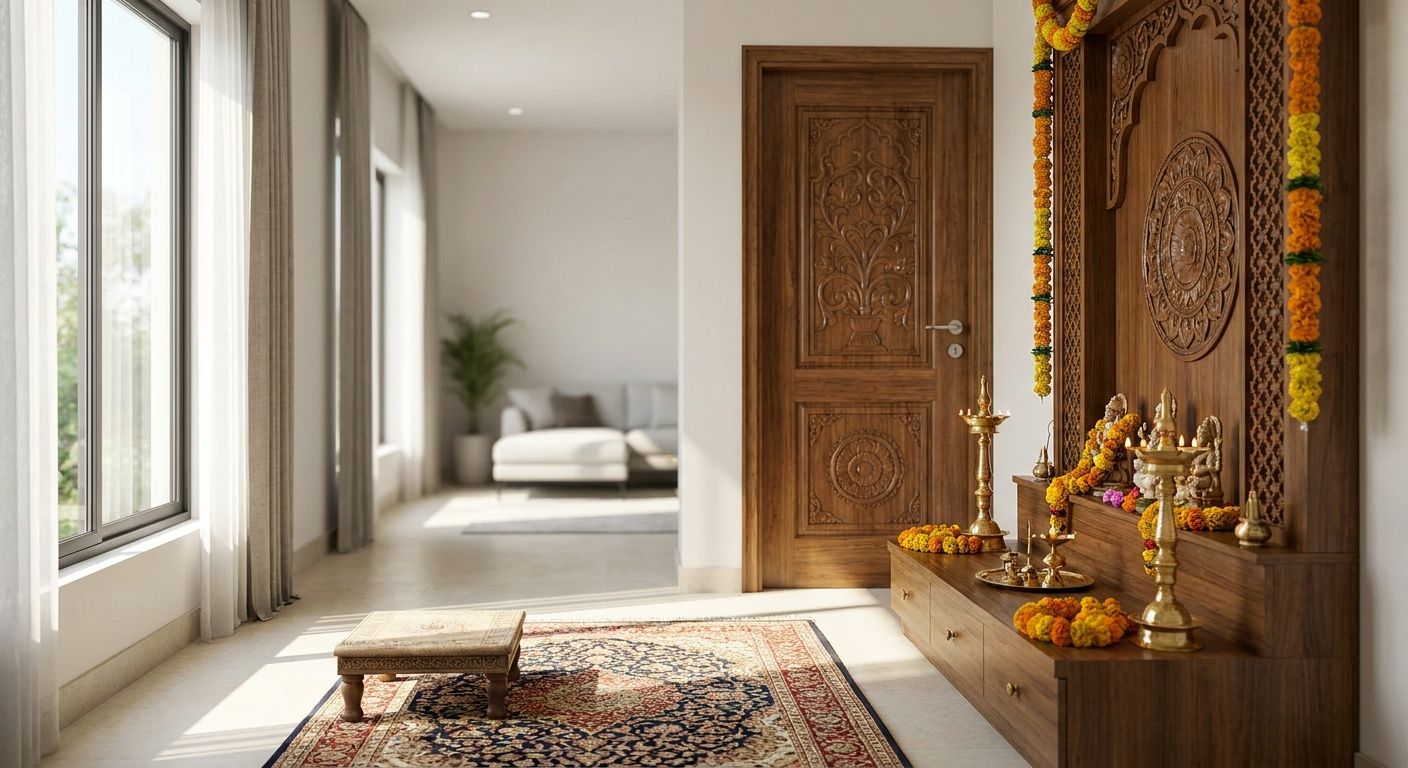
You want to know exactly where the mandir goes, which way it faces and which room ruins it if you get it wrong. Vastu for pooja room placement in 2026 comes down to five decisions: the direction, what sits above and below the space, how the idols are placed, what the door looks like, and what you're willing to compromise on if your home doesn't cooperate.
TL;DR
- Northeast (Ishanya) is the strongest direction for vastu for pooja room placement; a bedroom directly above it is the biggest deal-breaker.
- Under a staircase works only if nothing presses on the ceiling above the idols; otherwise skip it.
- Face east or north while praying; a south-facing idol is read as inviting stagnation, not just bad luck.
- A shared living-room altar beats no altar at all; direction matters more than square footage.
- Broken idols and a mandir directly opposite the main entrance undo everything else you got right.
Why a pooja room's placement actually matters
A home altar isn't decoration. In Vastu Shastra, direction and position are read as channels for energy, and a room that faces the wrong way or sits under the wrong load is treated as working against the household rather than for it. That's a bigger claim than most home design decisions carry, and it's why families still argue about this corner of the house before a single tile goes down.
The good news: the rules are specific enough to follow without a site visit. You don't need a Vastu consultant standing in your living room to know that a pooja room under a bathroom is a problem, or that facing south while you pray is read differently from facing east. Wishastro's free astrology tools cover chart-side questions like nakshatra and dasha; this guide handles the house.
Who this guide is for
This is for anyone deciding where the mandir goes: a family building a house from scratch with a floor plan still open to change, someone renovating an older home where the original pooja room sits in a spot nobody likes, or an apartment owner carving out a shelf or corner because a dedicated room isn't on the table. If you're choosing between three imperfect options rather than picking a blank slate, the guidance below is written for you specifically.
What to look for in vastu for pooja room placement
The direction: northeast first, east second
The northeast corner, called Ishanya, sits within the 0 to 45 degree arc measured clockwise from true north, and it's the direction most Vastu texts treat as the default for a home altar. East comes second, largely because it catches the morning sun and is read as the direction of new beginnings. If your plot lets you choose, start here and don't overthink the rest until this is settled.
What sits above, below and beside it
A pooja room stacked under a bedroom, bathroom or staircase landing is one of the most common vastu for pooja room mistakes, because the space above or below is treated as pressing down on or undermining the sanctity of the room. A kitchen next door is generally tolerated; a bathroom sharing a wall is not. Check the floor above before you check the floor plan of the room itself.
Which way you face while you pray
East or north are the directions you want to face while praying, which usually means the idols themselves should be positioned so you're looking east or north when you stand in front of them. South-facing worship is the one orientation Vastu consistently reads as working against you rather than neutrally.
Idol height and spacing
Vastu texts generally hold that idols shouldn't tower above the worshipper's chest height, since the room is meant to be approached, not looked up at like a monument. Idols also shouldn't touch the back wall directly; leave a small gap, at least a few inches, so the space reads as a shrine rather than a shelf.
Door, threshold and light
Wooden doors are preferred over metal, and black is the one color most guides tell you to avoid on a pooja room door. A slightly raised threshold and a door that opens inward rather than outward are small details that keep coming up across different regional traditions, which is usually a sign they're worth following even without a single authoritative source behind them.
Where to actually put it: room by room
Northeast corner of the ground floor. The classic call, and the reason it stays classic: it clears every major objection at once, direction, light and load above it. If your plot has an open northeast corner on the ground floor, this is the placement to build around. Ideal.
East wall of the living room. The apartment workaround, and a legitimate one. A shelf or small alcove on the east wall of a shared room beats no altar, or beats forcing one into a bathroom-adjacent spot just to get a separate room. The trade-off is privacy during prayer, not sanctity of direction. Workable.
A dedicated room on the top floor. The space to grow into, since a top-floor room clears the "nothing pressing down from above" rule automatically. The catch is what's directly overhead if there's a roof structure, and whether the room ever gets used for storage between prayers, which Vastu treats as a downgrade. Consider, with the storage caveat taken seriously.
Under the staircase. The space-saving trap that shows up in almost every renovation where square footage is tight. The structural load of the stairs above the idols is exactly the kind of "pressing down" Vastu warns against, and no amount of good lighting fixes that. Skip.
Inside the bedroom. The last resort, and workable only with real separation: a curtain or screen, idols never facing the bed directly, and the corner kept as northeast or east within the room itself. It's a compromise Vastu tolerates more than it endorses. Consider, cautiously.
What looks right but isn't
- Southwest placement. It's the direction Vastu reserves for stability and heavy furniture, not worship, so a pooja room here is read as working against the room's intended energy rather than neutrally sitting in it.
- A pooja shelf inside the kitchen. Common in small homes, and a compromise Vastu generally allows only if the shelf is on the northeast wall of the kitchen itself, not tucked next to the stove.
- A mandir directly facing the main entrance. It's meant to invite blessings in, but Vastu reads a direct sightline from the front door to the idols as letting energy pass straight through the house instead of settling into it.
Quick comparison
- Northeast, ground floor: direction correct, load correct. Ideal.
- East wall, shared room: direction correct, privacy limited. Workable.
- Top floor, dedicated room: load correct if not used for storage. Consider.
- Under the staircase: load incorrect regardless of direction. Skip.
- Inside the bedroom: workable only with real separation from the bed. Consider.
If you're timing the setup, the day you first place the idols is often chosen with a muhurat, an auspicious window, and some families check this against the household's lagna. If you don't know your exact birth time, you can still calculate your lagna without an exact birth time using the approximation method rather than skipping the step entirely.
When the floor plan genuinely has no good option, and both northeast and east corners are already committed to something structural, that's usually the point to talk to an astrologer online about which compromise costs the least, rather than guessing between two bad corners on your own.
One last thing
The detail most people skip: it's not the room that has to be perfect, it's the corner within the room. A bedroom, a landing, even a converted store cupboard can carry a functioning altar if the northeast or east corner inside that specific space is kept clear and the idols face the right way. Vastu for pooja room placement rewards the corner you actually control far more than the room label on the floor plan.