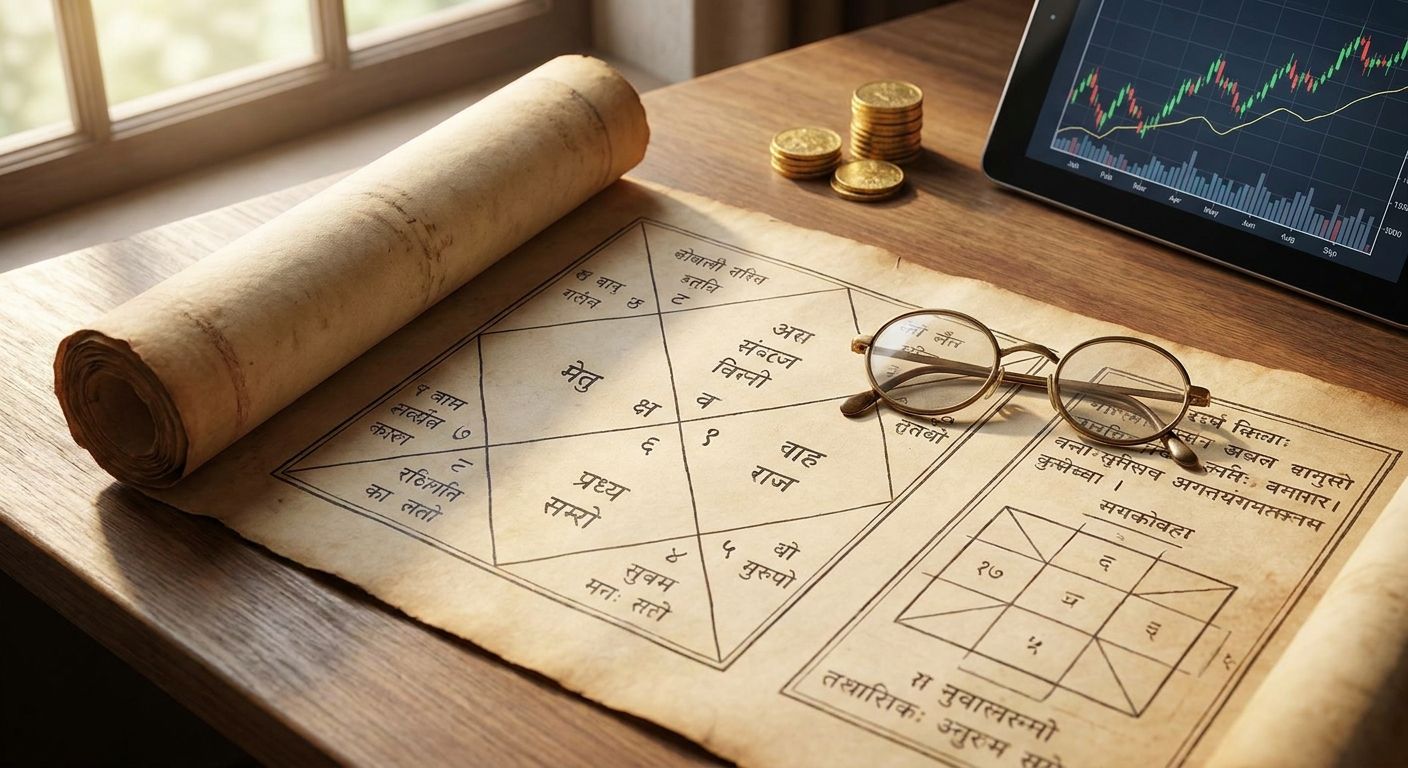
Kundli analysis for financial planning reads the 2nd, 9th and 11th houses of your birth chart, along with your current dasha (the planetary period that times when a planet's effects switch on), to show how money tends to move through your life and when it favors saving, spending or taking a real risk. It works best as something you revisit each year rather than a single verdict you read once and file away, which matters if 2026 is the year you're finally building a proper budget or weighing a career jump.
TL;DR
- Kundli for financial planning centers on the 2nd, 9th and 11th houses for income, luck and gains in 2026.
- Your current dasha matters more than your sun sign for timing a big money decision this year.
- Jupiter and Venus placements shape spending temperament more reliably than any single wealth yoga.
- Free birth chart and dasha tools cover the basics; a one-to-one reading adds the synthesis a chart alone can't.
Why Kundli Analysis Matters for Financial Planning
Money questions sit alongside marriage and career among the reasons people book a one-to-one kundli reading on Wishastro, and the reasoning behind that isn't mystical. A kundli (your Vedic birth chart, built from date, time and place of birth) assigns planets to houses, and each house governs a slice of life. The 2nd house rules income and saved wealth, the 11th rules gains and windfalls, the 9th rules fortune and long-distance money, and the 5th rules speculation. Read together, they tell you less about a fixed number and more about a pattern: whether your money tends to arrive steadily through salary, in lumps through gains, or through risk you take on deliberately.
Wishastro's readings use the sidereal zodiac with Lahiri ayanamsa (the gap between the sidereal and tropical zodiacs, which shifts a planet's sign by roughly 24 degrees from the Western tropical chart). Some tools online default to tropical placements instead, and the two can disagree on which sign a planet sits in, so it's worth knowing which system any answer you read is using before you act on it.
Map Your Wealth Houses First
Before you look at a single planet, find the houses that carry money in your kundli. Not every house pulls equal weight, and treating the 2nd house as the only "money house" is the single most common shortcut people take.
- 2nd house: income, savings, family-linked wealth
- 11th house: profits, windfalls, gains through networks
- 9th house: fortune, inheritance, income tied to travel or foreign ties
- 5th house: speculation, trading, investment appetite
- The planet sitting in each house, and the planet ruling it, colors how that house actually shows up in your life
Read Your Current Dasha Before Anything Else
A strong wealth house means little if the planet running your current dasha has nothing to do with it. Vimshottari dasha (the standard sequence Vedic astrology uses to time a chart) runs through each planet for a fixed stretch of years, and whichever planet is active tends to color that whole period.
- Identify which planet's dasha you're in right now
- Check whether that planet rules or sits in one of your wealth houses
- Note the sub-period (bhukti) planet running underneath it
- Weigh whether the dasha lord is strong or weak in your own chart, not just strong in general
- Ask how many years remain in the current period before it shifts
Check Jupiter and Venus for Spending Temperament
Jupiter and Venus say more about how you handle money day to day than most people expect from two planets. Jupiter tends to expand whatever it touches, which reads as generosity in a strong placement and overextension in a weak one. Venus governs comfort spending, so a well-placed Venus often means money flows toward beauty, partnership and pleasure rather than sitting untouched in a savings account.
- Note which house Jupiter occupies and what it rules there
- Check if Venus is combust, retrograde or aspected by Saturn, which tends to tighten its usual ease
- Look at whether Jupiter or Venus rules your 2nd or 11th house directly
- Watch for Rahu near either planet, which often pushes spending or earning toward something unconventional
Look at the Loss Houses Too
A financial reading that only looks at gain houses is half a reading. The 6th, 8th and 12th houses govern debt, disputes and hidden or unrecoverable expense, and a planet sitting there changes how safe a wealth combination actually is.
- 6th house: debt, loans, ongoing financial strain
- 8th house: sudden loss, joint finances, insurance and inheritance disputes
- 12th house: expenses abroad, money that leaves and doesn't return, charitable outflow
- A dosha (astrological affliction) touching these houses is worth naming, but check for cancellations before treating it as fixed
Use Your Lagna to Find Who Rules Your Money
Your lagna (ascendant, the sign rising at the exact moment of birth) decides which planet rules your 2nd and 11th houses in the first place. Get the lagna wrong and the entire wealth reading shifts to a different set of planets, which is why an inaccurate birth time causes more financial misreads than a weak Jupiter ever does.
- Confirm your birth time against a birth certificate or hospital record if you have one
- If you don't, you can still calculate your lagna without an exact birth time using rectification methods
- Recheck which planet rules your ascendant sign once lagna is confirmed
- Re-map the 2nd and 11th house lords against that corrected lagna
Cross-Check With Numerology If You Want a Second Lens
Mulank (your birth number, drawn from the digits of your date of birth) is a lighter, secondary way to read spending and earning habits, and it works better as a cross-check than a standalone answer. It's weaker on timing than a dasha and shouldn't replace one.
- Reduce your birth date to a single-digit mulank
- Read it alongside your 2nd and 11th house planets rather than instead of them
- Use it to sanity-check a spending pattern, not to override a dasha-based timing call
Book a One-to-One Reading When You Want It Synthesized
A chart gives you pieces: houses, a dasha, a lagna, maybe a dosha with or without cancellation. Putting those pieces into one coherent answer for your specific situation is where a chat with an astrologer earns its place, and you can talk to an astrologer online for free to see how that synthesis works before booking a full session.
Get your kundli read for money questions
Talk through your wealth houses and current dasha with an astrologer.
Comparing Your Options
| Option | Best for | Key limitation |
|---|---|---|
| DIY kundli reading with a free birth chart tool | Readers comfortable interpreting houses and planets themselves | Misreads lagna easily without an accurate birth time |
| Dasha calculator | Timing questions like whether this is a strong year to invest | Doesn't explain what the dasha does to your specific houses |
| Numerology mulank check | A quick secondary lens on spending habits | Weaker on timing than dasha; works better as a cross-check |
| One-to-one astrologer chat | Synthesizing wealth houses, dasha and lagna into one answer | Depends on the astrologer's read, not a guarantee of an outcome |
Common Mistakes People Make
- Reading the 2nd house alone. The 2nd house covers savings, but the 11th (gains) and 9th (fortune) carry just as much weight in a full money picture.
- Naming a dasha planet without checking its strength. "Jupiter dasha is good for money" only holds if your Jupiter is well-placed; a weak or afflicted Jupiter dasha can read the opposite way.
- Ignoring small birth time errors. A 15 to 20 minute gap can shift your lagna into a different sign, which changes who rules your 2nd and 11th houses entirely.
- Mixing tropical and sidereal placements. A planet's sign under Lahiri ayanamsa often differs from its tropical placement, and comparing the two without noting which system you're using leads to a reading that doesn't match either tradition.
- Treating a dosha as a financial verdict. A dosha touching a wealth house is a factor to weigh, not a guaranteed loss, especially once you check whether anything in the chart cancels it.
One Last Thing
The detail most people miss: the 5th and 9th houses form a trine (trikona) with each other and with the 1st house in classical Jyotish, and their lords connecting to the 2nd or 11th house is what actually forms a dhana yoga, not the 2nd house sitting alone with a strong planet in it. If you're reading your own chart for the first time in 2026, start there instead of staring at the 2nd house and wondering why the picture feels incomplete.