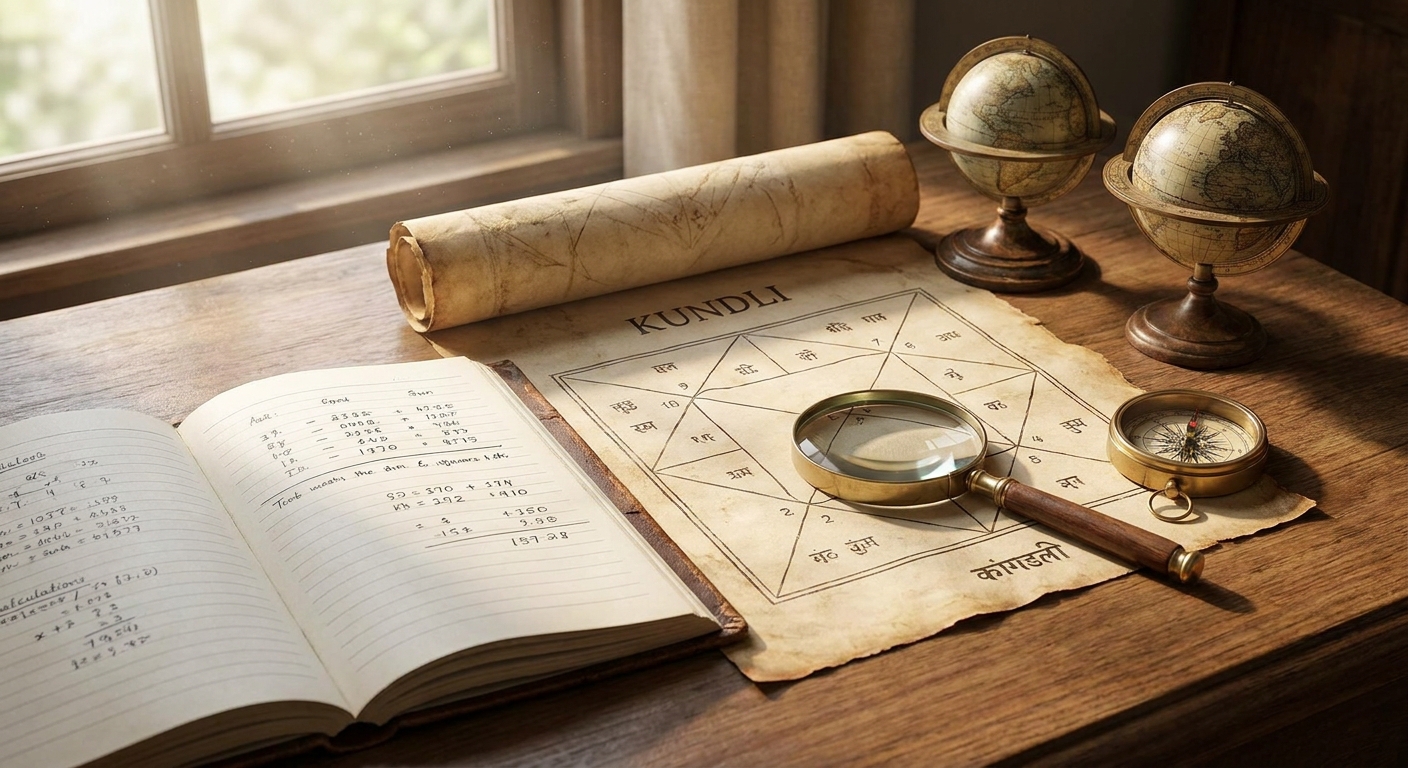
Rahu and Ketu move fast compared to the slow outer planets, and that speed is exactly why most kundli readings gloss over the details. This guide shows you how to actually track their transit against your natal chart step by step, no guesswork.
TL;DR
- Rahu Ketu transit effects on your kundli show up strongest in the houses they cross from your natal Moon and lagna.
- Rahu and Ketu change signs roughly every 18 months, so recheck your chart at each shift.
- Matching the transit against an active Rahu or Ketu dasha period sharpens the reading, don't skip this cross-check.
- A 10-minute Wishastro consultation clears up conflicting predictions faster than three different apps.
Why this matters
Rahu and Ketu are shadow points, not physical planets, and that's precisely why their transit effects confuse people the most. They don't have their own light, so their influence depends entirely on which house and nakshatra they're passing through in your specific kundli.
Two people born on the same day in the same city can read the same generic "Rahu transit 2026" article and get nothing useful out of it, because the houses affected depend on their individual lagna. That's the gap this guide closes. You'll pull your own placements, map them against the current transit, and know exactly which life area to watch this year, without relying on someone else's chart.
Check your placements against the free tools on Wishastro before you start, since the natal Rahu Ketu axis is the baseline everything else in this guide compares to.
What you'll need
- Your exact birth date, time, and place (minutes matter for house cusps)
- A generated kundli showing natal Rahu and Ketu house placements
- The current Rahu Ketu transit sign and nakshatra for 2026
- Your running dasha and antardasha period (Rahu dasha or Ketu dasha changes the weight of the transit)
- A notebook or notes app to log observed effects over 2-3 months
- Optional: a 15-20 minute consultation slot if two readings conflict
The steps
1. Pull up your natal Rahu Ketu placement first
Before you touch any transit data, confirm where Rahu and Ketu sit in your own kundli, by house and by sign. This is the fixed reference point every transit reading gets compared to, so getting it wrong here throws off every step after it.
Use a birth-time-accurate chart generator, not a rough guess. The kundli matching tool explains how date-of-birth precision affects chart accuracy, and the same logic applies here. A 20-minute birth time error can shift Rahu from your 6th house to your 7th house, and those two houses mean completely different things.
Common mistake: using an approximate birth time from memory instead of the hospital certificate. Even a 15-minute gap can move house cusps enough to change the entire reading.
2. Find the current Rahu Ketu transit position for 2026
Rahu and Ketu shift signs roughly every 18 months, so the transit position you check in January 2026 may not hold by mid-year. Confirm the current sign and nakshatra pada through a live panchang or transit calculator before mapping anything.
Write this down alongside your natal chart. You're building a two-column comparison: natal house on one side, transit house on the other.
3. Count the transit house from your lagna, not from the Moon sign
This is where most self-readings go wrong. Vedic transit analysis counts houses from your ascendant (lagna) for overall life effects, while Moon-based counting (Chandra Rashi) is used for a secondary, mind-and-emotion layer. Do both, but keep them labeled separately.
If Rahu transits your 3rd house from lagna, expect movement in courage, siblings, and short travel. The same transit counted from your Moon sign might land in your 8th house instead, pointing at stress and sudden change. Both readings matter, they just answer different questions.
Common mistake: mixing the two counts into one paragraph. Keep lagna-based and Moon-based transit notes in separate columns so you're not blending two different signals.
4. Check the nakshatra pada overlap, not just the sign
A transit through the same sign as your natal Rahu can still feel completely different depending on the nakshatra pada. Rahu transiting Ashwini feels sharp and impulsive; the same Rahu transiting Bharani in the same sign leans more toward restriction and effort.
Match the pada, not just the rashi. This step alone explains why two people with Rahu in the same sign report different year experiences.
5. Cross-check against your current dasha period
A Rahu Ketu transit lands harder when you're already running a Rahu dasha or Rahu antardasha, and softer when your dasha lord has no connection to the axis at all. This is the single biggest factor apps skip, because dasha calculation needs a precise birth time to run correctly.
If your dasha lord sits in the same house the transit is currently activating, treat that period as a priority window for 2026, not background noise.
6. Track houses 1, 4, 5, 7, 8, and 10 first
Rahu Ketu transits through these six houses tend to produce the most visible, real-world shifts: identity and health (1st and 8th), home and emotional base (4th), children and creative decisions (5th), partnerships and marriage (7th), and career (10th). If the current transit touches any of these from your lagna, log it as a priority house.
Transits through 2, 6, 9, 11, and 12 tend to run quieter, showing up as slow internal shifts rather than sudden events.
7. Compare against weekly patterns, not a single reading
A single chart reading gives you the structure, but weekly movement shows you the texture. Checking a live weekly forecast, like the Aries weekly horoscope, against your dasha notes for a few weeks helps you see whether the transit is peaking or easing.
Common mistake: treating the transit as a single static event. Rahu Ketu effects build over the full 18-month sign transit, they don't hit all at once on day one.
8. Log actual outcomes for 8-10 weeks
After mapping the theory, track what actually happens in your life against the houses you flagged. Note career shifts, relationship friction, sudden expenses, or unexpected opportunities, and date each entry.
After 8-10 weeks, compare your log against the predicted house effects. This is what separates a real kundli reading from a generic 2026 forecast, your log is specific to your chart, not a template.
Troubleshooting
I don't know my exact birth time. Approximate charts still show the sign, but house placements can be off by a full house. Use a birth time rectification service or an astrologer consultation before trusting house-level Rahu Ketu conclusions.
Two apps give me different transit houses. This almost always comes down to house system differences (whole sign versus Placidus) or a rounding error in birth time. Pick one system and stick with it for consistency across your log.
My dosha report says something scary and the transit reading contradicts it. Dosha reports and transit reports answer different questions, one is structural, one is time-based. Don't let a generic dosha score override a specific, dated transit reading of your own chart.
I can't tell if I'm in Rahu dasha or just a Rahu transit. Dasha runs for years, transit runs for about 18 months. Check your dasha timeline separately; if both overlap, that's your priority window for 2026.
The nakshatra pada calculation feels off. Pada boundaries are narrow, about 3 degrees 20 minutes each. A birth time error of even 10 minutes can shift you into the neighboring pada, so double check against a precise chart generator.
I'm tracking correctly but nothing matches my life. Give it the full 8-10 week window before drawing conclusions. Rahu Ketu effects are gradual, not instant, especially in the quieter houses.
Tools and resources
- A precise kundli generator using your exact birth date, time, and place
- The kundli matching guide for understanding how birth-time precision changes house readings
- A live panchang for confirming current Rahu Ketu sign and nakshatra pada
- Weekly horoscope checks, like the Aquarius horoscope today page, for short-term pattern tracking
- A dasha calculator to confirm your running Rahu or Ketu period
- A notes log for recording dated, real-world outcomes over 8-10 weeks
What to do next
Once you've mapped the transit and logged a few weeks of outcomes, the next useful step is getting a second read from someone who does this daily. Self-tracking catches the pattern; a live consultation catches the nuance a static chart reading misses, especially around dasha overlap.
Get your Rahu Ketu transit read
Talk to an astrologer about your specific kundli and current dasha.
One last thing
The detail most people skip is the nakshatra pada, not just the sign. Two charts with Rahu in the same rashi but different padas, say Ashwini versus Bharani, read completely differently, one impulsive and fast-moving, the other slow and restriction-heavy. If your Rahu Ketu transit tracking isn't matching your year so far, recheck the pada before you recheck anything else.