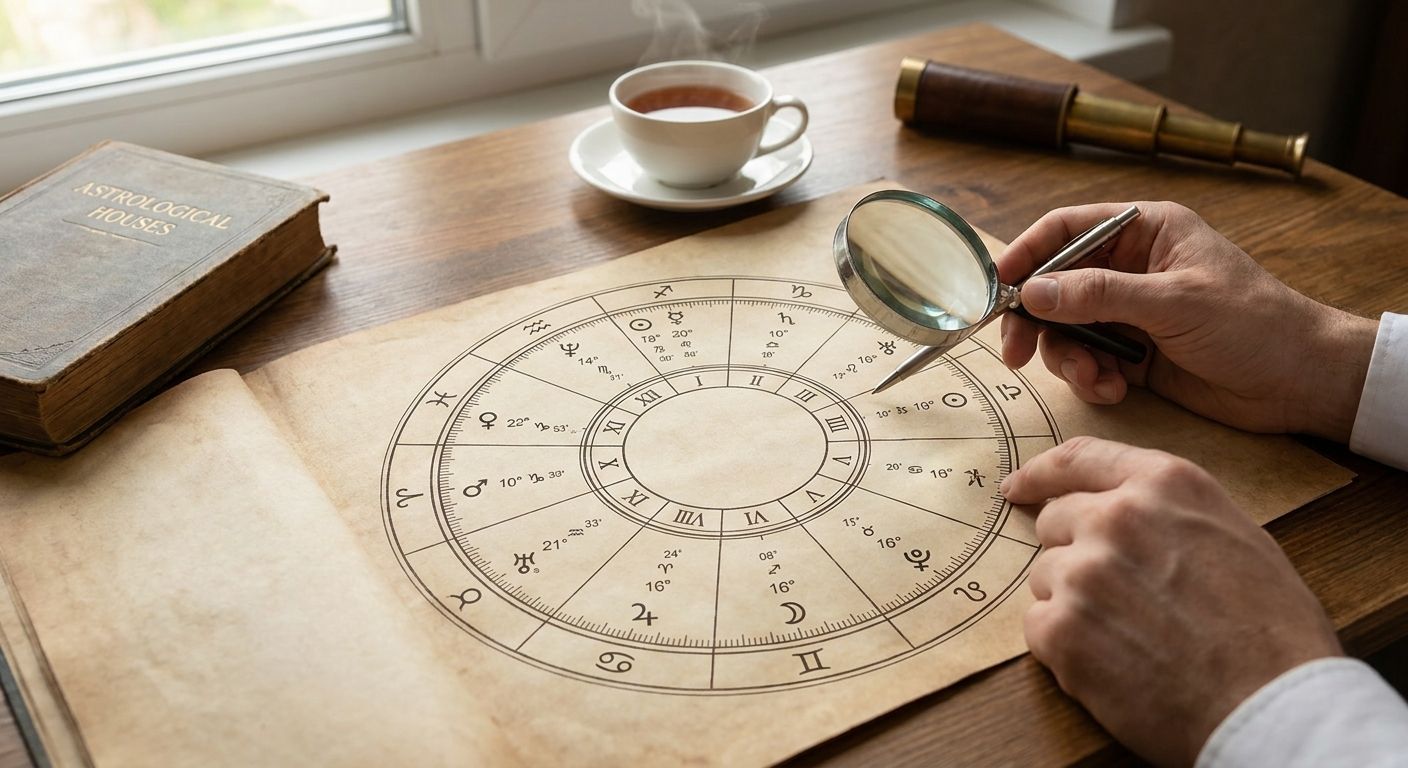
The 12 houses in your birth chart, the bhavas, turn planets and signs into a life read one section at a time: self, money, siblings, home, romance, and on into career, gains and the quieter losses. This is the order to read them in, step by step, so the chart stops looking like noise and starts reading like a map in 2026 and any year after.
TL;DR
- Reading the 12 houses in your birth chart starts with confirming your lagna (ascendant), not your Sun sign.
- Vedic astrology uses the whole-sign house system, so each house holds one full 30-degree sign, unlike Western equal-house charts.
- The four kendras (1st, 4th, 7th, 10th) carry the most weight for self, home, marriage and career reads.
- Houses 6, 8 and 12 are the dusthanas, read for friction rather than doom, once cancellations are checked.
- A house without a planet still speaks through its lord's placement, so an empty 7th house is never actually empty.
Why this matters
A birth chart with the right planets in the wrong houses gets misread constantly. Someone sees Jupiter and assumes good fortune everywhere, without checking which house Jupiter actually sits in and which house it rules. The house is what turns a planet's general nature into a specific life area: Jupiter in the 10th house reads differently from Jupiter in the 12th, even though it's the same planet in the same sign.
Vedic astrology treats the 12 houses in a birth chart as fixed territory, 30 degrees each under the whole-sign system, starting from your lagna and moving anticlockwise. Skip that order and every reading after it drifts. Get the houses right first, and everything layered on top, nakshatras, dasha periods, actually holds up heading into 2026.
What you'll need
- Your exact birth date, time and place, since the lagna shifts roughly every two hours
- A confirmed lagna (ascendant), not just your Moon sign or Sun sign
- A list of where each of the 9 grahas sits, house by house
- A basic grip on the whole-sign house system (each house is one full sign, unlike the Western equal-house or Placidus methods)
- 20 to 30 minutes of quiet reading time; rushing through 12 houses in five minutes produces a shallow read
If you don't have an exact birth time, calculate your lagna without an exact birth time before doing anything else. Guessing the lagna throws off every house that follows, and that mistake doesn't fix itself just because you found the right approach in 2026.
The steps
1. Confirm your lagna first, not your sun sign
Your lagna, the sign rising on the eastern horizon at your birth, becomes the 1st house and the anchor for every other house. Western horoscope columns run on the Sun sign; Vedic house reading runs on the lagna, and mixing the two produces a chart that reads wrong from the first house onward.
Check your lagna against your birth certificate time if you have it. A birth time off by even 15 minutes can shift the lagna into a neighbouring sign, which changes all 12 houses, not just the first one.
2. Assign the twelve houses using the whole-sign method
Once the lagna is fixed, count forward: your lagna sign is the 1st house, the next sign anticlockwise is the 2nd house, and so on through the 12th. Each house holds exactly one sign and spans the full 30 degrees, unlike the Western equal-house or Placidus systems, which can slice a house unevenly around the cusp.
This step is mechanical, not interpretive. Get the numbering wrong here and the rest of the read is guesswork dressed up as insight.
3. Read the four kendras: 1st, 4th, 7th, 10th
The kendras, the 1st, 4th, 7th and 10th houses, carry the most structural weight in a chart: self, home, marriage and career. A planet sitting in a kendra tends to act with more force, for better or worse, than the same planet tucked into a quieter house.
The 7th house in particular gets scrutinised in marriage matching. If you're comparing two charts rather than reading just one, how kundli matching works using just date of birth covers how 7th houses and Moon positions get weighed against each other.
4. Read the trikonas: 1st, 5th, 9th
The trikonas, the 1st, 5th and 9th houses, are read as the luck houses: children and intelligence in the 5th, father and fortune in the 9th. A well-placed benefic here, Jupiter or Venus, tends to soften rough patches elsewhere in the chart, which is one reason two people with identical Sun signs live very different lives.
5. Read the dusthanas: 6th, 8th, 12th
The dusthanas, houses 6, 8 and 12, get named the trouble houses, and the reputation isn't entirely undeserved: enemies and disease in the 6th, sudden loss and transformation in the 8th, expenses and isolation in the 12th. Named plainly, not feared blindly: the 6th also governs debt recovery and competitive wins, so a strong 6th house can describe someone who thrives on conflict rather than someone doomed by it.
Every dusthana has cancellations worth checking before treating a placement as a final verdict. A benefic aspecting the house, or its lord sitting in a kendra or trikona, tends to soften the read considerably.
6. Read the remaining houses: 2nd, 3rd, 11th
The 2nd governs family wealth and speech, the 3rd covers siblings, courage and short journeys, and the 11th reads gains, income and the friend circle you keep. These three don't get the drama of the kendras or dusthanas, but they're where the daily texture of a life shows up: how you talk, what you earn, who sticks around.
7. Check which planets sit in each house, and which planets rule it
A house is never truly empty. Even with no planet physically in the 7th house, that house still has a ruling planet, its lord, sitting somewhere else in the chart, and that placement carries the house's story. An empty 7th house with its lord sitting in the 10th, for instance, often reads as a marriage shaped heavily by career timing.
Cross-check both: what's sitting in the house, and where the house's own lord has landed. Reading one without the other is the single most common mistake in house interpretation.
8. Match the house reading to your current dasha
The Vimshottari dasha system runs on a 120-year cycle split across the 9 grahas, from a 6-year Sun period to a 19-year Saturn period. A house only fully activates once its ruling planet, or a planet sitting inside it, runs its dasha or sub-period. Someone with a strong 10th house for career might not see that payoff until their 10th lord's dasha actually arrives, sometimes well into their thirties or forties.
This is why a chart can look promising on paper for years before anything visibly changes: the house was always there, but the timing hadn't caught up yet, in 2026 or whichever year the dasha finally lands.
Want a second read on your houses?
Talk through your chart with an astrologer, no urgency, whenever you're ready.
Troubleshooting common house-reading problems
You don't know your exact birth time. Work from the birth certificate or hospital record if you have either; even a rough window narrows the lagna to one or two candidate signs, which beats a wild guess.
Two planets sit in the same house. Read both, but weigh the stronger one first: a planet in its own sign or exalted in that house tends to dominate the read over a debilitated one sharing the space.
A house looks completely empty. It isn't. Trace the house's lord to wherever it sits in the chart; that placement carries the house's story even without a resident planet.
Software gives a different house than a book example. Confirm which system is being used. Whole sign, equal house and Placidus can place the same planet in different houses near a cusp, and the whole-sign method used here in 2026 hasn't changed since the texts that codified it.
A dusthana placement feels like a life sentence. Check for cancellations first: a benefic's aspect, or the house lord sitting in a kendra or trikona, changes the read substantially before you write off a placement as fixed.
The house reading doesn't match how life has actually gone. Check the dasha. A house can sit dormant for years until its ruling planet's dasha period activates it, so a 5th house for children that looks strong on paper might not show results until well into the relevant dasha.
Tools and resources
- Birth chart and kundli tools plot the 9 grahas across the 12 houses in your birth chart without needing a sign-up; the chart itself saves to a private link you can revisit.
- All of these tools, birth chart, kundli, dosha and dasha calculators, sit on Wishastro, so a house read and a dasha check can happen in the same sitting in 2026.
- Keep a saved copy of your chart nearby while working through the steps above; flipping back to check a house's lord halfway through step 7 is normal, not a sign you missed something.
What to do next
The houses only tell part of the story. Layer the nakshatra, the Moon's lunar mansion, on top of the house and sign for a finer read, especially around the 5th house and children. How to choose a baby name using nakshatra walks through that layer if a naming decision is what brought you here.
One last thing
The 8th house gets the worst reputation of the twelve, tied to sudden loss and endings, but it's also the house of shared resources: inheritance, insurance payouts, in-laws' money, and research work that goes deep rather than wide. A strong 8th house lord shows up as often in people who marry into family wealth or work in insurance and research as it does in people dealing with loss. Read the whole house before deciding which half of its story is yours, whether you're checking this in 2026 or a decade from now.
Related guides
- Aries weekly horoscope for how current transits move through these houses week to week.