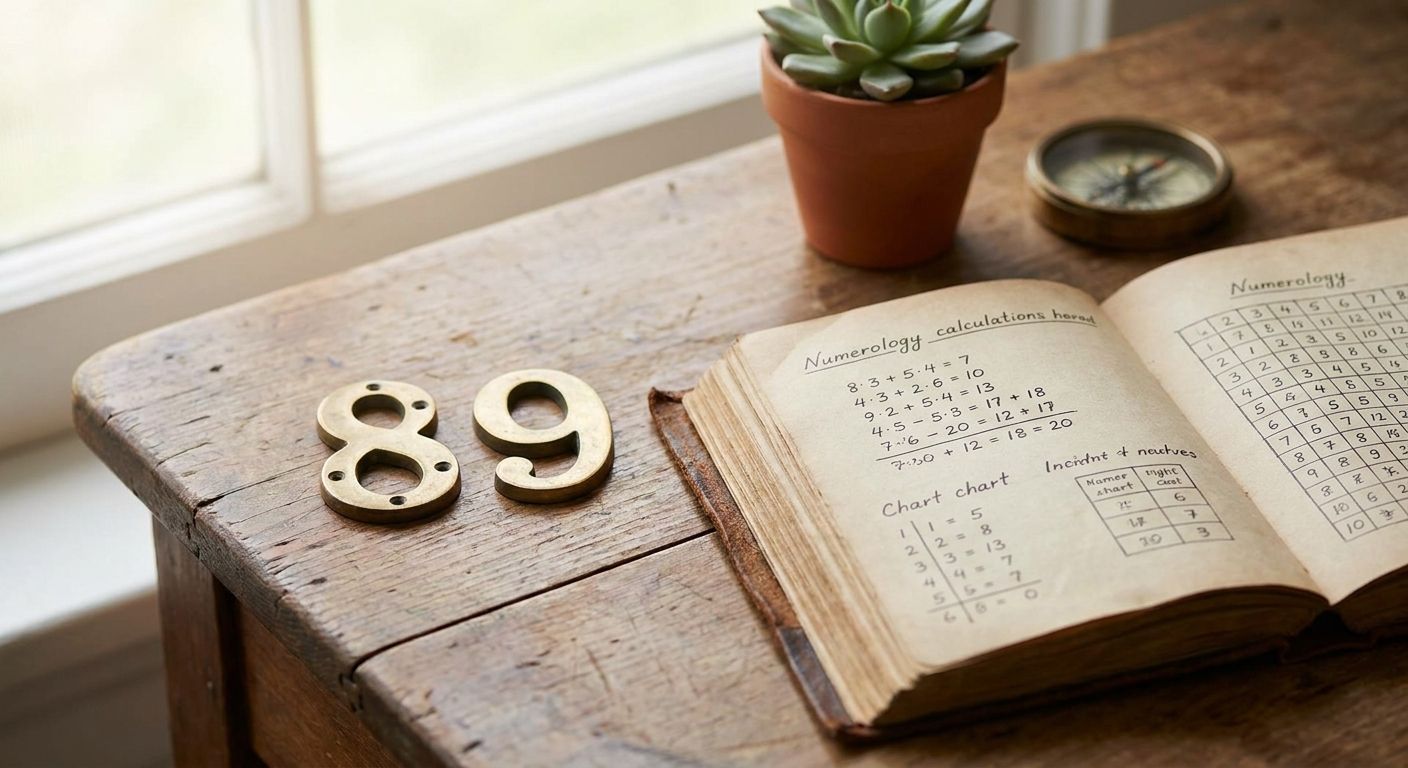
Lucky house number numerology is arithmetic, not guesswork: reduce the address to one digit, compare it against your own birth numbers, and read what tradition says about the pairing.
TL;DR
- Lucky house number numerology works by reducing the address digits and comparing them to your mulank, the birth-date root number.
- Bhagyank, summed from your full date of birth, gives a second, slower reading of the same house number.
- Tradition treats 1, 3, 5, 6 and 9 as easier pairings for more mulanks than 4 or 8, but neither number is a verdict on its own.
- A house number you can't change still works: read the pairing, adjust habits or interiors, don't move over a digit.
Why this matters
House numbers get lumped in with Vastu, but numerology treats them on their own terms: not room layout, just the digits on the plate. If you're flat-hunting in 2026 and weighing two addresses, the numerology check is quick and doesn't need a full chart pulled first, just your birth date and the number itself. Wishastro's free tools cover this alongside kundli, dasha and nakshatra calculations, so you can run the digits before you commit to anything.
This isn't Vastu, and it isn't a substitute for looking at the chart of everyone who'll live in the house. It's one layer, and it's the fastest one to check.
What you'll need
- Your exact date of birth, day, month and year
- The house, flat or plot number you're checking, digits only
- A pen and paper, or Wishastro's numerology tool for the digit sums
- The number-planet pairing list below, five minutes to read through
The steps
Step 1: Work out your mulank
Mulank is the root number, drawn only from the day you were born, never the month or year. Add the digits of your birth date until one digit remains. Someone born on the 28th adds 2+8=10, then 1+0=1, so their mulank is 1. Tradition reads this number as the tone of your everyday temperament, and it's the first number you test the house address against.
Common mistake: pulling in the month or year here out of habit. Mulank only ever uses the day.
Step 2: Work out your bhagyank
Bhagyank, sometimes called the destiny number, sums every digit of the full date, day, month and year, down to one digit. Someone born on 15 August 1994 adds 1+5+0+8+1+9+9+4=37, then 3+7=10, then 1+0=1. Tradition treats bhagyank as the longer arc your mulank has to work inside, so a house number that clashes with your mulank but sits well against your bhagyank isn't an automatic no.
Common mistake: stopping at two digits, at 37 or at 10, instead of reducing all the way to one.
Step 3: Reduce the house number itself
Add every digit in the number, the same way you did your own birth date. House 425 becomes 4+2+5=11, then 1+1=2. The building name and the street name don't enter the sum, only the numerals printed on the plate or the agreement.
Common mistake: folding in a floor number or a block letter that isn't actually part of the address's numeral.
Step 4: Check the number-planet pairing
Each single digit in this system carries a planet: 1 the Sun, 2 the Moon, 3 Jupiter, 4 Rahu, 5 Mercury, 6 Venus, 7 Ketu, 8 Saturn, 9 Mars. Tradition reads friendly pairs, 1 with 3, 5 and 9 among them, as an easier daily fit, and reads a Rahu-Saturn pairing like 4 and 8 as more friction than ease, though this varies by school.
Common mistake: treating one hard pairing as a verdict on the whole house rather than a single data point.
Step 5: Cross check with your bhagyank
Run the same friend, neutral or clashing comparison against your bhagyank. If mulank and bhagyank disagree, most numerologists working in this tradition weight the mulank more heavily for daily household mood and the bhagyank more heavily for long-run fortune, though neither cancels the other out.
Common mistake: picking whichever number gives the answer you wanted and dropping the other.
Step 6: Weigh compound numbers on their own terms
Look at the full number before you reduce it. Traditional numerology treats certain compound numbers, 16 and 26 among them, as carrying their own reading beyond the single digit they eventually reduce to. A flat numbered 16 reduces to 7, but 16 gets read on its own terms first in this tradition, not skipped straight to 7.
Common mistake: jumping straight to the single digit and missing the compound number's own reading.
Step 7: Decide how to work with a number you can't change
Most renters, and plenty of owners in allotted housing, never get to pick the number. If yours reduces to a pairing tradition treats as harder, the usual response in this practice isn't to move: it's a nameplate adjustment, an interior change, or simply awareness of the pattern. A harder pairing calls for attention, not fear, and it doesn't override your own say in how the space gets used, or the house's Vastu layout, or your own chart.
Common mistake: treating one difficult number-planet pairing as fixed fate rather than one input among several.
Troubleshooting
My flat number has a letter, like 12-A. This system counts digits only; letters don't carry numeric value the way Western, name-based numerology assigns them. Read 12-A as 1+2=3 and set the letter aside.
My mulank and bhagyank point in opposite directions. Weight the mulank for how the house feels day to day, and treat the bhagyank as the slower, longer read; neither one cancels the other.
The building has no allotted number yet. Use the number on the builder's allotment letter for now, and run the sum again once the final plate goes up, since numbers do occasionally shift before possession in 2026-era projects still under construction.
My society won't let me change the number plate. Nobody in this tradition asks you to move house over a digit; work with the plate you have and treat the reading as awareness, not a verdict.
I got a different answer from a Western numerology site. Western, Pythagorean numerology also assigns values to the letters in your name and folds that into the total; this method sticks to digits only, on the birth date and the address, so the two systems won't always agree.
Tools and resources
- Wishastro's numerology tool works out your mulank and bhagyank from your birth date, so you're not doing the addition twice.
- How kundli matching works using just date of birth runs a similar friend-or-clash comparison, on two charts instead of a chart and a number.
- A pen and paper covers the reduction steps on their own; the tool just saves you the arithmetic.
What to do next
Numerology gives a fast read on a house number, but it's one layer among several, alongside Vastu and the chart of the people actually living there. If a number keeps bothering you and you want it looked at properly, talking to an astrologer online brings in dasha and lagna alongside the digits, which a number on its own can't account for.
One last thing
Compound numbers get skipped more than they should. A flat numbered 16 reduces to 7, but 16 carries its own traditional reading in this system before you ever get to the single digit, and jumping straight to 7 misses half of what builders in India have quietly worked around for years, renumbering the 13th floor or skipping unit 4 in more towers than most buyers notice when they sign in 2026.