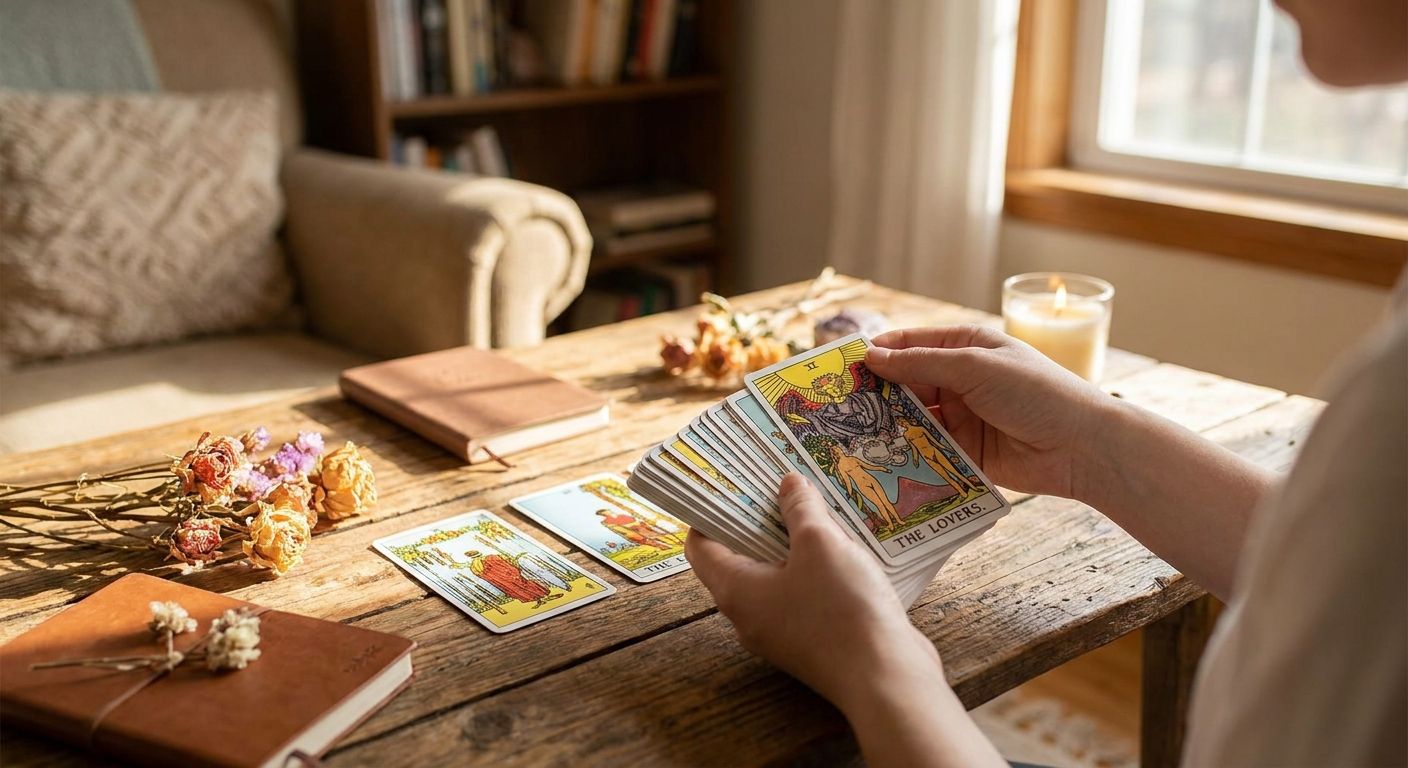
A tarot reading for love and relationships works when you ask a real question, pick a spread that matches its weight, and read the cards for what they show instead of what you were hoping to pull. Here is how to run one yourself, card by card, in 2026.
TL;DR
- A three-card spread answers most love questions in under 10 minutes: past, present, likely direction. Start here.
- Reversed cards in a love reading usually mean delay, not refusal; read them as blocked energy first.
- Ask what you need to see rather than will they come back; open questions make a tarot reading for love and relationships useful.
- The same card returning across three separate readings about one person is the pattern, not bad luck.
- A reading that raises a question the deck cannot settle is a fair reason to book a one-to-one astrologer chat.
Why this matters
Most people who search for a tarot reading for love and relationships already know the answer they want; the cards only help when you let them answer a different question. A spread read honestly names the actual pattern in a relationship: where the connection is real, where one side is still guarded, where a decision keeps getting pushed back. That instinct is close to what a birth chart does with a compatibility question, minus the drama. If you want the Vedic side of a relationship question too, kundli matching using just date of birth works from the same premise: read the pattern, not the wish.
Most love tarot questions in 2026 fall into one of three shapes: should I stay, is this person right for me, or what happens next if I do nothing. Each shape needs a different spread, and picking the wrong one is the single biggest reason a reading feels vague or contradictory.
What you'll need
- A standard 78-card tarot deck; the Rider-Waite-Smith deck is the easiest one to learn on
- 10 to 20 minutes without your phone buzzing
- A specific question, written down before you shuffle
- A flat surface to lay the cards on
- Optional: a notebook or notes app to record the spread and revisit it later
The steps
1. Write the exact question before you touch the deck
A vague question gets a vague spread. "What do I need to see about this relationship right now" pulls a usable reading; "will he come back" pulls a card that can be read three different ways depending on your mood that evening. Write the question down on paper, not just in your head, and keep it in front of you while you lay the cards. The common mistake here is asking about someone else's feelings instead of your own next move; tarot reads intention and pattern, not a second person's mind.
2. Shuffle until it feels done, then cut the deck into three
Shuffle for as long as you need, there is no fixed count, and stop when it feels settled rather than rushed. Cut the deck into three piles and reassemble them in any order you like. This step exists to break the deck's factory order and let the draw feel less mechanical; skipping it is fine occasionally, but doing it every time builds the habit that keeps a reading from feeling like a coin flip.
3. Pick a spread size that matches the question's weight
A three-card spread (past, present, likely direction) suits a quick check-in and takes about five minutes. A five-card relationship cross adds "what you bring" and "what they bring" and runs closer to ten minutes. The ten-card Celtic Cross is built for a real crossroads decision and takes twenty to twenty-five minutes to read properly. The mistake most beginners make is running a Celtic Cross on a question that only needed three cards, which buries a simple answer under nine cards it doesn't need.
4. Lay the cards face up in fixed positions
Each position in a spread carries a fixed meaning: position one is the past influence, position two is the present, position three is the likely outcome if nothing changes. Lay every card face up as you draw it and do not peek ahead. Reading a card out of its position, treating a "past" card as a prediction, is the fastest way to misread a spread that was actually accurate.
5. Read each position on its own before you combine them
Name what the card in position one means without reference to the others first: the Two of Cups in the past position says the connection was mutual at some point, full stop. Only after you have named each card alone should you start connecting them. Jumping straight to "the whole spread means" skips the step that actually builds reading skill, and it is the difference between a reading you can explain and one you can only feel.
6. Read the combination, not just the single cards
This is where a tarot reading for love and relationships earns its keep. The Two of Cups next to the Three of Swords in one spread is not a contradiction; it is a relationship carrying both real connection and unresolved hurt at the same time, which is a far more useful answer than either card gives alone. Look for repeating suits (all Cups points to emotion driving the situation, all Swords points to unresolved conflict or decisions) and repeating numbers across the spread.
7. Treat reversed cards as delay, not a verdict
A reversed card in a love spread almost always means the energy of that card is blocked, slow, or internal rather than absent. A reversed Two of Cups is not "no connection"; it is a connection that has stalled or gone quiet on one side. New readers routinely read a reversal as the deck saying no, which turns a nuanced answer into a flat rejection the cards never actually gave.
8. Close with one decision and a date to review it
End every reading by writing down one concrete takeaway and a date to check back, two weeks out is standard. A reading that produces no decision at all was probably run on a question that was too big for the spread you chose. Revisiting the same question every day until you get the answer you want defeats the purpose; the deck will just keep repeating itself back at you.
Troubleshooting
Two cards seem to contradict each other. Read them as a timeline instead of a standoff: one describes where things stood, the other describes where they're heading, and both can be true at once.
The same card keeps turning up across separate readings about one person. If the same card turns up in three separate readings about one relationship, stop reshuffling for a different answer: that card is the pattern, not bad luck.
You're reading for someone who isn't sitting across from you. Reframe the question back to your own side of the exchange; tarot cannot read a person who never touched the deck, only your relationship to the situation.
Reversals confuse you more than they help. Read the deck upright only for your first ten readings and add reversed meanings once the upright ones feel automatic.
You can't tell what you want to see from what the card actually shows. Write down the literal image on the card before you write down what it means; that gap is usually where wishful reading creeps in.
Tools and resources
- If a spread keeps circling a chart-linked question and you don't have an exact birth time on hand, calculate your lagna without an exact birth time walks through the workaround.
- The Vedic compatibility route mentioned earlier works alongside tarot rather than replacing it; run both if you want two independent readings on the same relationship.
- When a reading raises a question the deck genuinely can't settle on its own, that's a fair reason to talk to an astrologer online for a one-to-one conversation on Wishastro rather than pulling a ninth card hoping for clarity.
Want a second opinion on the reading?
Book a private one-to-one chat with an astrologer on Wishastro.
What to do next
Run the three-card spread first, even if your question feels bigger than three cards can hold; you can always follow up with a five-card or Celtic Cross reading once you know which direction the answer is pointing. Keep a simple log of the question, the cards, and the date, because a tarot reading for love and relationships gets more accurate to you personally the more of your own past readings you can compare it against. Most people who stick with this for a few months in 2026 stop needing the guide at all and start reading the combinations on sight.
One last thing
The Two of Cups showing up without the Ace of Cups anywhere nearby is usually a sign of an established connection that has gone quiet, not a match still forming; most beginners read it as unqualified good news and miss that distinction entirely. Cards don't rank happy or sad on their own; a stalled Two of Cups and a forming one look almost identical unless you check what's sitting next to it.