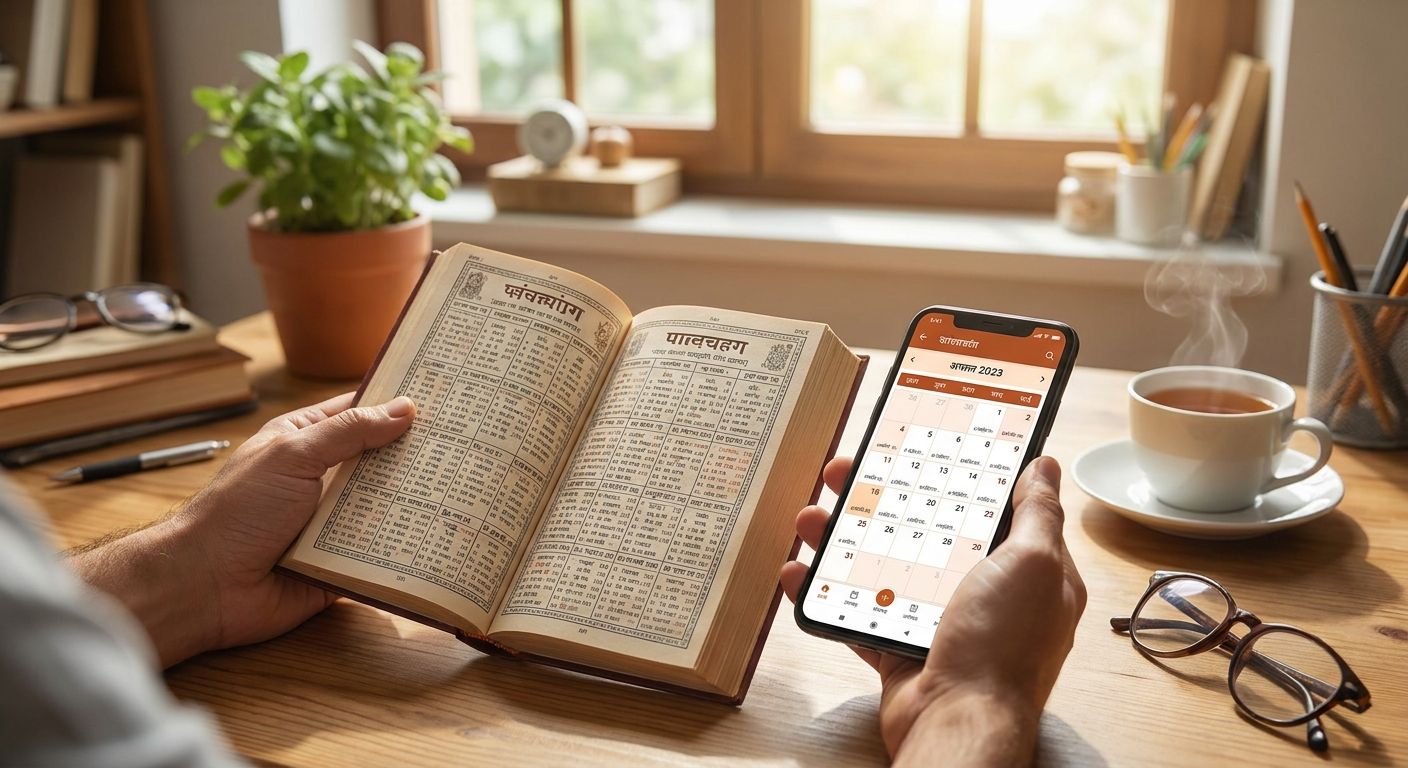
Checking today's Choghadiya muhurat takes about five minutes once you know your local sunrise time. This guide walks through the sunrise-based math, the day-lord sequence, and how to read the eight daily windows so you can pick one for travel, a purchase, or a small ceremony without guessing.
TL;DR
- Choghadiya muhurat today runs on sunrise time, not the clock, so a 6:02am sunrise resets the whole sequence.
- Amrit, Shubh, and Labh are the three Choghadiya types worth building a schedule around; Rog and Kaal are the ones to avoid.
- The day's starting Choghadiya is fixed by the weekday's ruling planet: Sunday opens with Udveg, Monday with Amrit.
- Manual math drifts by minutes, so cross check with a panchang before locking a wedding or launch time.
- Choghadiya is a daily filter, not a personal chart reading, so major decisions still deserve a look at your kundli.
Why this matters
Choghadiya divides daylight into eight equal parts and the night into another eight, each carrying one of seven names: Udveg, Chal, Labh, Amrit, Kaal, Shubh, and Rog. One name repeats within the day since eight slots share seven categories. The system predates the mechanical clock, which is why it starts counting from sunrise rather than midnight; a task attempted at 1am in Vedic reckoning still belongs to the previous day's chart.
People reach for Choghadiya because it's fast. A full muhurat reading against your kundli takes real calculation and, for anything with weight, a conversation with an astrologer. Choghadiya gives you a same-day filter: good enough for booking a cab to catch a flight, not the tool for setting a wedding date. Wishastro's guides on chart mechanics cover the deeper end of this; this page stays on the daily, sunrise-based layer.
What you'll need
- Your local sunrise and sunset time for today (use your actual city, not a nearby one; a 15-minute difference shifts every slot)
- The day of the week, since the starting Choghadiya changes with the ruling planet of that day
- A notepad or a panchang app to divide daylight into eight equal parts
- Ten minutes, since the math is simple but easy to rush
- Optionally, a sense of what the task needs: travel, a purchase, a ceremony, or a hard conversation, since that decides which Choghadiya type you're hunting for
If you've ever tried calculating a lagna without an exact birth time, the sunrise dependency here will feel familiar. Both systems anchor to the sun's position for the day rather than a fixed clock hour.
The steps
1. Get today's sunrise and sunset time
This is the single number the whole calculation hangs on. A panchang app or a basic sunrise search for your city gives you this in seconds; write down both sunrise and sunset, since you'll need the gap between them.
Expected outcome: two clock times, for example 6:04am and 6:38pm. Common mistake: using a sunrise time from a different city or a rounded time from memory. A 10-minute error here shifts every Choghadiya boundary by roughly 10 minutes too.
2. Find the length of daylight and divide it by eight
Subtract sunrise from sunset to get total daylight hours, then divide that span into eight equal parts. If sunrise is 6:04am and sunset is 6:38pm, that's roughly 12 hours and 34 minutes of daylight, so each Choghadiya slot runs about 94 minutes.
Expected outcome: eight time blocks covering sunrise to sunset. Common mistake: dividing by 12 out of habit because a day "has 12 hours"; Choghadiya always uses eight parts regardless of the season's actual daylight length.
3. Identify today's ruling planet
Each weekday has a ruling planet in Vedic reckoning: Sunday is Sun, Monday is Moon, Tuesday is Mars, Wednesday is Mercury, Thursday is Jupiter, Friday is Venus, and Saturday is Saturn. This decides which Choghadiya opens the day.
Expected outcome: you know which of the seven names starts your first daylight slot. Common mistake: confusing this with your personal Moon sign or lagna; the day-lord here belongs to the calendar day, not your birth chart.
4. Apply the day-start sequence
Each day begins with a fixed Choghadiya and then cycles through the same seven names in order until the eighth slot repeats the first. Sunday opens with Udveg, Monday with Amrit, Tuesday with Rog, Wednesday with Labh, Thursday with Shubh, Friday with Chal, and Saturday with Kaal.
Expected outcome: a labelled list of eight daylight slots for today. Common mistake: applying yesterday's sequence to today because the date changed at midnight rather than at sunrise.
5. Repeat the division for the night portion
Sunset to next sunrise gets its own eight-part division, following on from where the daylight sequence left off. Night slots run longer in winter and shorter in summer, exactly the way daylight slots do in reverse.
Expected outcome: eight labelled night windows. Common mistake: assuming night Choghadiyas carry the same names in the same order as daylight; the cycle continues rather than restarting.
6. Flag the favorable windows for your task
Amrit, Shubh, and Labh read as generally favorable: Amrit for anything you want to start clean, Shubh for ceremonies and announcements, Labh for anything involving money or negotiation. Chal is mixed, workable for travel and movement precisely because "chal" means moving. Rog, Kaal, and Udveg read as unfavorable and are usually skipped for anything you'd rather not repeat.
Expected outcome: two or three windows on your list marked as usable. Common mistake: treating Chal as fully auspicious; it's workable for motion, not ideal for signing anything permanent.
7. Cross check with a panchang before committing
Manual division is accurate to the minute if your sunrise time is right, but a panchang app or website removes the arithmetic risk entirely and is worth the extra step for anything you'd regret getting wrong. Treat your own calculation as a first pass, not the final word.
Expected outcome: your manual result matches the panchang within a few minutes. Common mistake: trusting a generic table found online that wasn't built for your city's sunrise time.
8. Weigh it against your personal chart for anything major
Choghadiya is a daily filter that applies to everyone equally; it says nothing about your dasha, your lagna, or what a particular planet is doing in your chart right now. For a wedding date, a big purchase, or a career move, a favorable Choghadiya is a bonus on top of a personal reading, not a replacement for one. You can talk to an astrologer online for free to get that second layer before locking a date that matters.
Expected outcome: a decision that's supported by both the daily panchang and your personal chart. Common mistake: picking a date purely because it lands in an Amrit window while ignoring a hard transit in your own chart.
Troubleshooting
Two apps show different Choghadiya boundaries for the same day. This almost always traces back to a sunrise time mismatch; check that both sources are using your exact city and not a regional default.
A favorable window is too short for your task. A wedding ceremony rarely fits inside one 90-minute Amrit slot; look for a day where two favorable Choghadiyas sit back to back, or accept that only part of the ceremony needs to fall inside the window.
The table you found online doesn't match the weekday sequence described here. Some sources publish the night sequence and label it as the day sequence by mistake; recheck which portion of the 24 hours the table is covering.
Someone tells you Rahu Kaal and Choghadiya are the same thing. They aren't: Rahu Kaal is a single fixed inauspicious window each day, while Choghadiya is the full eight-part daylight and eight-part night cycle. A day can have a bad Rahu Kaal and a fine Choghadiya sequence at the same time.
Your Choghadiya pick conflicts with a kundli-based muhurat you were given. Defer to the kundli-based reading for anything personal and significant; Choghadiya is generic to the calendar day, a kundli muhurat is built around your own chart and carries more weight.
Tools and resources
- A sunrise and sunset time for your exact city, refreshed daily
- A panchang app or website to cross check manual division
- Wishastro's guide on calculating lagna without an exact birth time, useful background if you're also trying to time something against your rising sign
- Wishastro's piece on choosing a baby name using nakshatra, relevant if the muhurat you're checking is for a naming ceremony
- A notepad, since eight time slots are easy to lose track of without writing them down
Check a bigger decision with an astrologer
Get a personal read on your chart before locking a major date.
What to do next
Once you're comfortable reading a single day's Choghadiya, the natural next step is understanding how a personal muhurat differs from a generic one, especially if you're timing something as significant as a wedding. Wishastro's explainer on how kundli matching works using just date of birth is a reasonable place to see how personal chart data changes the calculation compared to the calendar-wide Choghadiya cycle covered here.
One last thing
The part most people skip is the eighth window, the one that repeats the day's opening Choghadiya right before sunset or right before the next sunrise. It's easy to assume the cycle just ends after seven names, but that final repeated slot is real and worth checking if your task lands late in the day; it carries the same reading as the first window of the morning, for better or worse.