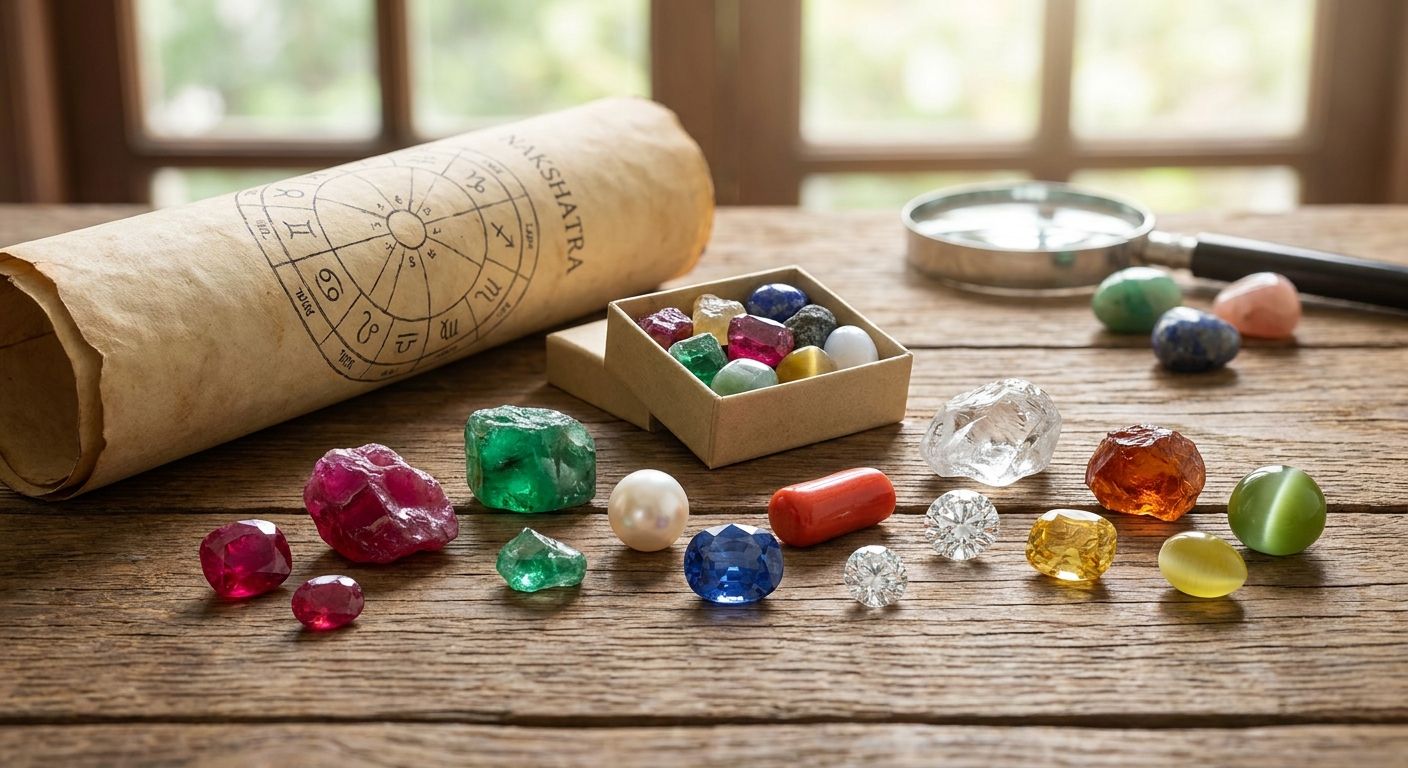
If you searched for gemstones by nakshatra, you have probably seen lists that assign a stone to each birth star. The traditional logic is narrower: the stone follows the planet that rules the nakshatra. That gives nine recurring planet-stone links across 27 nakshatras, not 27 unique prescriptions.
This article is for guidance and reflection, not a substitute for professional medical, financial or gemological advice. Gemstone effects described in Jyotish are traditional beliefs, not established medical or scientific outcomes.
TL;DR
- A rashi spans 30 degrees, while each nakshatra spans 13 degrees 20 minutes.
- The 27 nakshatras share nine planetary rulers, with three nakshatras assigned to each ruler.
- Ruby, pearl, yellow sapphire and diamond are classical planetary gems, but they are not a universal low-risk group.
- Gemstone trials are a lineage-dependent custom, not a universal rule or a test of physical safety.
- A gem report can identify the stone and disclose detectable treatments. It cannot certify an astrological effect.
Start with the correct zodiac geometry
A rashi spans 30 degrees of the zodiac. A nakshatra spans 13 degrees 20 minutes, so each rashi contains parts of more than one nakshatra.
Birth time still matters, but the common claim that a 20-minute error automatically changes the nakshatra is wrong. The Moon moves about 0.18 degrees in 20 minutes on average. That is enough to cross a boundary only when the Moon was already close to one. The ascendant moves much faster, so the same error may matter more for lagna and house placement.
Use the nakshatra finder with the most accurate birth details you have. If the Moon falls near a boundary, compare the surrounding times before treating one nakshatra as certain.
How the traditional mapping works
The nakshatra lords repeat in the Vimshottari sequence: Ketu, Venus, Sun, Moon, Mars, Rahu, Jupiter, Saturn and Mercury. Classical navaratna lists then associate one principal gem with each of those grahas.
Planet | Nakshatras | Classical gemstone |
|---|---|---|
Ketu | Ashwini, Magha, Mula | Cat's Eye |
Venus | Bharani, Purva Phalguni, Purva Ashadha | Diamond |
Sun | Krittika, Uttara Phalguni, Uttara Ashadha | Ruby |
Moon | Rohini, Hasta, Shravana | Pearl |
Mars | Mrigashira, Chitra, Dhanishta | Red Coral |
Rahu | Ardra, Swati, Shatabhisha | Hessonite |
Jupiter | Punarvasu, Vishakha, Purva Bhadrapada | Yellow Sapphire |
Saturn | Pushya, Anuradha, Uttara Bhadrapada | Blue Sapphire |
Mercury | Ashlesha, Jyeshtha, Revati | Emerald |
This is why Rohini, Hasta and Shravana all point to pearl in the traditional list: the three share the Moon as nakshatra lord. The mapping describes a lineage of practice. It does not establish that a stone changes health, mood, work or relationship outcomes.
Four classical gems, not four universal benefics
Ruby, pearl, yellow sapphire and diamond correspond to the Sun, Moon, Jupiter and Venus. Calling all four "benefic stones" or "low-risk picks" oversimplifies Jyotish. Planetary classifications and functional roles change with the chart and the school of interpretation. A gem linked to a planet is not automatically suitable simply because the planet is described favorably in another context.
The same caution applies to Red Coral and Emerald. Traditional practitioners may consider the ascendant, house rulership, dignity, aspects and current dasha before recommending either one. Those judgments are interpretive, not a medical diagnosis or a measurable safety screen.
What a gemstone trial can and cannot tell you
Some contemporary practitioners recommend briefly trying Blue Sapphire, Hessonite or Cat's Eye before permanent wear. That custom is not uniform across Jyotish lineages, and it does not prove that a stone is helping or harming you astrologically.
Sleep changes, arguments and mood shifts have many ordinary causes. Do not use them as a diagnostic test for a gem. For physical safety, focus on the setting, metal allergies, sharp edges and whether the ring or pendant fits securely. Stop wearing jewellery that irritates your skin and seek medical advice for persistent symptoms.
What to check before buying
Confirm the stone rather than relying on the label
Ask for an independent laboratory report on a costly gem. The report can identify whether the material is natural or laboratory-grown and note detectable treatments. It cannot certify spiritual potency or guarantee a life result.
Set a budget before a consultation or sales visit
No evidence-based carat formula links body weight to astrological effectiveness. Treat weight, metal, finger and weekday instructions as tradition-dependent customs. A seller should be able to separate the gem's identity and price from claims about what it will do for you.
Keep the decision reversible
Check the return policy, obtain the report number, and have an independent jeweller inspect an expensive setting. Avoid financing a stone on the promise that it will repair a career, marriage, health condition or financial problem.
What to avoid
- Treating a month-based Western birthstone list as a nakshatra chart.
- Assuming any gem is universally beneficial or risk-free.
- Using a few days of mood or sleep changes as proof that a stone suits the chart.
- Accepting a body-weight or carat rule as a tested dosage.
- Paying a premium for a report that supposedly certifies astrological power.
One last thing
The useful part of the nakshatra system is the mapping itself. Ashwini, Magha and Mula occupy different parts of the zodiac, yet all three connect to Ketu and Cat's Eye in the traditional list. Keep that correspondence separate from claims of guaranteed results, and the subject becomes much easier to discuss honestly.