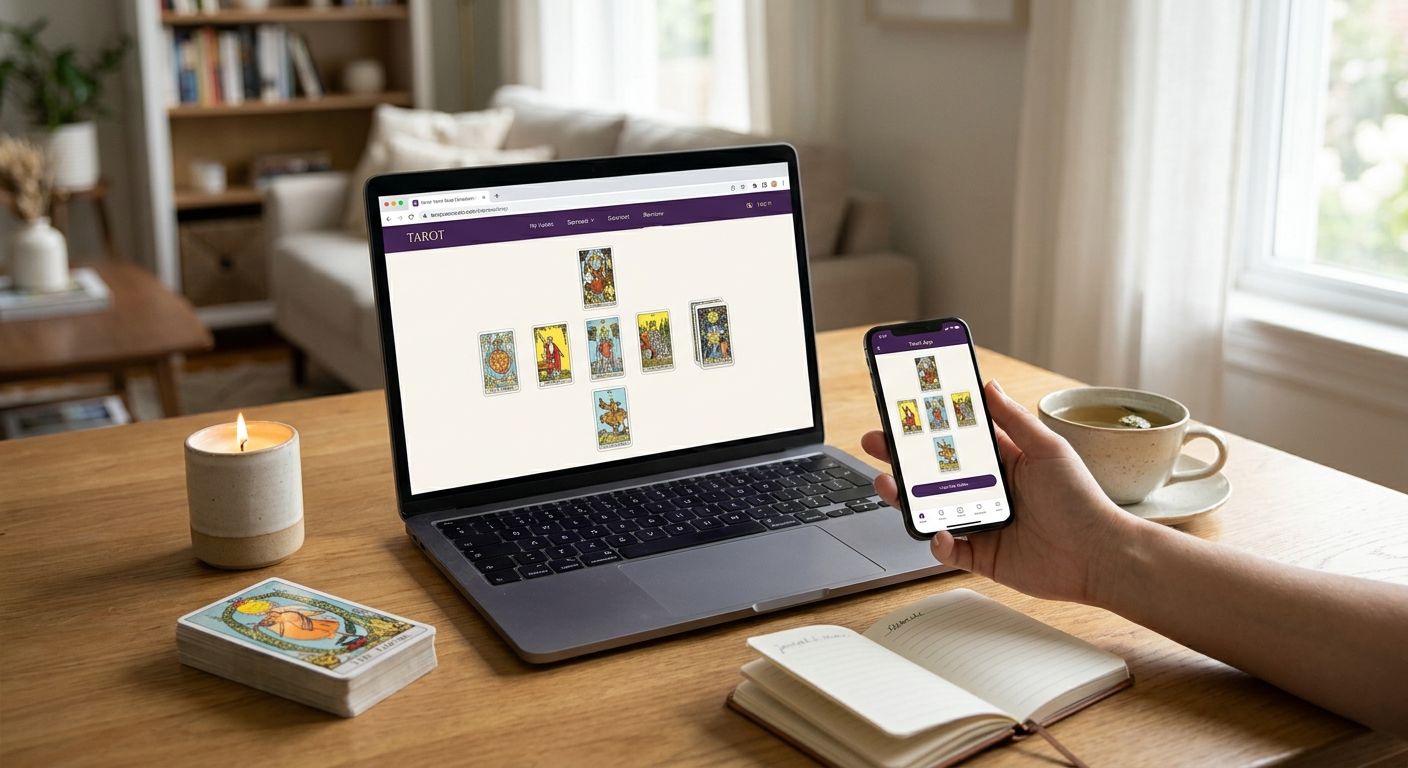
Most "free tarot reading" pages online recycle the same three cards no matter when you click, and the ones that don't often bury the interpretation behind a paywall two clicks in. Sorting the tools that actually shuffle from the ones that don't takes about ten minutes, and this guide does that sorting for you.
TL;DR
- Wishastro's free tarot reading tool draws from the full 78-card deck with no sign-up required: Buy.
- Labyrinthos wins for people who want to learn the deck, not just get an answer: Buy.
- Trusted Tarot is fine if you already use it but not worth switching to: Hold.
- Skip generic daily-draw widgets that recycle the same handful of major arcana cards for drama.
- A genuine 78-card draw returns a minor arcana card about 72% of the time; constant major arcana pulls are a red flag.
Why this matters
A tarot spread is only as good as the deck behind it. A full tarot deck has 78 cards: 22 major arcana (the archetypal cards like The Tower or The Star) and 56 minor arcana split across four suits. A tool that quietly limits itself to a dozen "dramatic" cards to keep readings exciting isn't reading anything, it's performing.
That distinction matters more in 2026 than it did a few years back, because free tarot pages have multiplied and most of them exist to sell you something after the free pull. Wishastro runs its tarot reading tool without asking for a sign-up first, and the result saves to a private link rather than disappearing when you close the tab.
How this list was ranked
Each tool here was compared on three plain measures: whether it draws from the full 78-card deck or a shortened list, whether a sign-up gate sits between you and the reading, and how specific the card interpretation actually gets once you draw. A tool that hands you "The Empress means abundance" and stops there scores lower than one that ties the card to the position in the spread.
This isn't a lab test with a sample size to quote. It's a straight feature comparison across the free tarot tools people actually search for in 2026, weighted toward the ones that show up in real reader questions.
The ranked list
1. Wishastro's free tarot reading
The pick that doesn't nudge you toward a paid pull halfway through. The tool draws from the full deck, so a three-card spread genuinely can land on minor arcana cards like the Six of Cups instead of cycling through the same twelve majors. No account is needed to run it, and the reading saves to a private link you can return to later.
It sits inside a wider set of free tools, including birth chart and kundli calculators, which is useful if a tarot pull raises a question that's really a chart question. Verdict: Buy.
2. Labyrinthos
The study tool for someone who wants to learn the 78 cards, not just receive an answer and move on. Labyrinthos pairs its draws with a spaced-repetition card game, so the meanings start to stick instead of resetting after every session.
It's slower than a quick daily pull and that's the point: if you want to actually read your own cards by year-end, this is the one that teaches instead of just answering. Verdict: Buy.
3. Trusted Tarot
A long-running free site with a straightforward three-card spread and a separate love-focused draw. It doesn't gate the reading behind an account, which puts it ahead of most competitors on that single point.
The interpretations run generic once you scroll past the headline sentence, and the layout hasn't changed much in years. Fine if it's already bookmarked; not worth switching to in 2026 if you're starting fresh. Verdict: Hold.
4. Golden Thread Tarot
A well-designed app with original card art and a journaling feature that logs past draws. The free tier caps how many spreads you get before it asks for a subscription, and the ad load on the free version has grown over the past couple of years.
If the art style matters to you more than the mechanics, it's worth a look; otherwise the free cap makes it a middle-of-the-road option. Verdict: Wait.
5. Generic daily-draw widgets (Astrology.com and similar)
These single-card-a-day tools show up high in search results because they're embedded on large horoscope sites, not because the draw logic is strong. Many recycle a short rotation of major arcana cards to keep the daily card feeling eventful, which defeats the purpose of a random draw.
If a "random" daily card keeps landing on The Tower or The Star, the deck isn't being shuffled, it's being curated. Verdict: Skip.
6. Biddy Tarot's card library
Not a draw tool at all, but a reference library with a long-form meaning for every card in the deck, upright and reversed. Useful after you've drawn a card somewhere else and want the fuller interpretation than a one-line summary gives you.
Treat it as a dictionary, not a reading, and it earns its place in the rotation. Verdict: Buy (for lookups, not draws).
Where these tools stand side by side
- Full 78-card deck, no sign-up: Wishastro's tarot tool, Labyrinthos, Trusted Tarot.
- Best for learning the deck long-term: Labyrinthos, with Biddy Tarot's library as the backup reference.
- Best for a quick free three-card pull with no account: Wishastro's tarot reading tool.
- Worth paying for if you're already invested: Golden Thread Tarot, once you're past the free cap.
- Skip for daily use: generic single-card widgets bundled into large horoscope sites.
Where to try these tools
Three rules keep the search simple. First, if a tool asks for payment before you see a single card, close the tab; the tools worth using in 2026 offer at least one real free spread. Second, check whether the interpretation names the position in the spread (past, present, outcome) or just the card meaning in isolation; position-aware readings are the ones worth returning to.
Third, if a tarot pull keeps surfacing the same question about a relationship, a job change or a family decision, a card is a starting point, not a full answer. That's the moment to talk to an astrologer online instead of drawing a fourth card hoping for a clearer one.
One last thing
Most people never check whether a "random" daily tarot card is actually random. Do the math once: with 56 of 78 cards being minor arcana, a genuine random pull should land on a minor arcana card roughly seven times out of ten. If a free tool's daily draw feels dramatic every single day, minor arcana cards like the Four of Swords or the Nine of Pentacles should still be showing up nearly three times out of four. When they don't, the tool is picking for engagement, not shuffling for you, and that's worth knowing before you take any single draw too seriously in 2026.