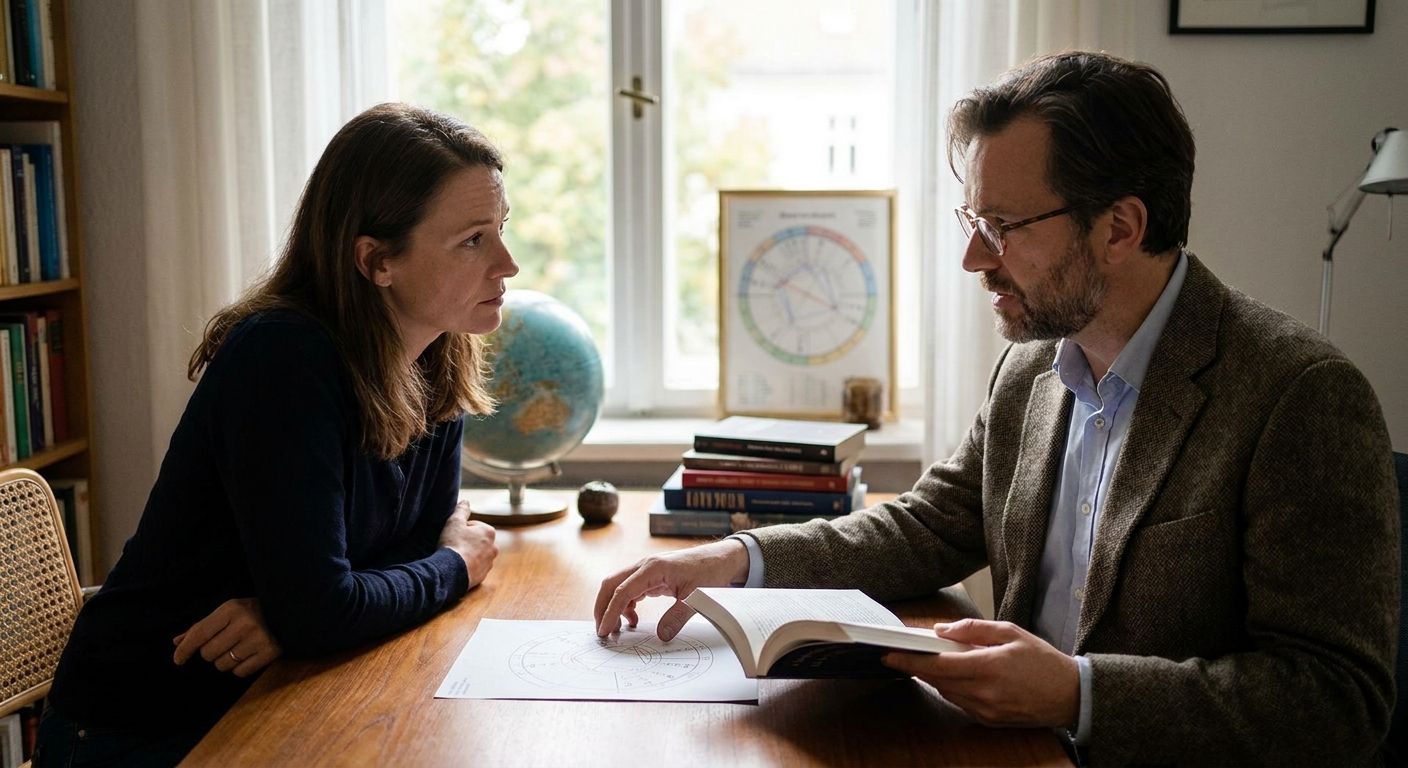
Divorce and separation involve safety, law, money, housing, family, and grief. A person may still want an astrology session as part of private reflection, but the session cannot determine whether to stay, leave, reconcile, file a case, or agree to custody terms. Those decisions need real-world information and qualified support.
TL;DR
- An astrologer may discuss relationship symbolism in a natal chart, current dashas, or transits.
- A chart cannot prove why a relationship is struggling or whether the relationship can be repaired.
- Astrology should never decide safety, separation, custody, property, support, or legal strategy.
- A responsible practitioner avoids fixed timelines, blame, and fear about children or future partners.
- Speak with the right professional for each practical decision before treating an astrology session as meaningful guidance.
Important: Astrology is for guidance and reflection only. It is not a substitute for a lawyer, licensed counselor, mental health professional, financial adviser, or domestic violence service. If you or a child may be in immediate danger, contact local emergency services or a trusted local support organization.
Put safety and practical advice first
Before booking any reading, separate the questions that astrology cannot answer. A lawyer can explain rights, deadlines, documents, property, support, and custody. A licensed counselor can help with communication, grief, and decisions about reconciliation. A financial professional can help you understand accounts, debt, and a post-separation budget.
If there is coercion, stalking, violence, or fear of retaliation, make a safety plan with a qualified local service. Do not ask an astrologer to assess whether a partner is dangerous or whether it is safe to disclose plans.
What a bounded astrology session may cover
Some Jyotish practitioners associate the 7th house with partnership and may discuss its lord, planets placed there, or aspects recognized by their school. They may also use dashas and transits to frame a period of strain, withdrawal, conflict, or reassessment. These are traditional interpretations, not findings about what caused the relationship or what either partner will do next.
A practitioner might compare two charts if both people consent and reliable birth details are available. The comparison should not be used to label one person as the problem. It also cannot establish abuse, honesty, compatibility, or the likely outcome of counseling.
No placement supports claims such as conflict beginning after a fixed number of years, a dasha showing a structural mismatch, or a chart proving that pressure will ease on its own. Those claims sound specific, but the chart cannot validate them.
Boundaries to set before the session
Tell the astrologer what you will not delegate. Useful boundaries include: no instruction to stay or leave, no prediction about a court result, no reading of a child's chart to shape custody or transition plans, and no remedy sold as protection from a spouse.
Ask the practitioner to name the chart factors being interpreted and to state uncertainty plainly. If the session turns into blame, moral judgment, or pressure to buy another service, end it.
Questions that keep the conversation reflective
- What traditional themes do you associate with this period?
- Are you reading a natal placement, a dasha, or a current transit?
- Which parts of the interpretation are uncertain?
- Can we discuss my own responses without diagnosing my partner?
- Can you avoid predictions about legal outcomes, children, or reconciliation?
A useful answer may help you name a feeling or pattern you want to discuss with a counselor. It should not replace that conversation.
Claims to reject
Do not accept a promise that a remedy will stop a divorce, bring a partner back, secure custody, or settle a conflict with relatives. Be wary of anyone who uses Mangal Dosha, Saturn, Rahu, or another factor to assign guilt. Predictions about a child's temperament should not guide how adults handle a separation. A child specialist or family therapist is the appropriate source for that support.
Likewise, a compatibility score is not evidence for a legal or personal decision. Consent, conduct, safety, communication, and the advice of relevant professionals matter more than a chart comparison.
If you still want a reading
Choose it after you have identified the legal, safety, financial, and counseling questions that need professional answers. Keep the astrology question narrow and personal, such as what you want to reflect on during a difficult period.
The relationship compatibility consultation page is the relevant Wishastro route. A session there should remain separate from any legal, clinical, or safety plan.
What a responsible session leaves behind
You should leave with a limited, clearly labeled traditional interpretation, not a verdict. The next decision should still be made with the people qualified to help with its real consequences.