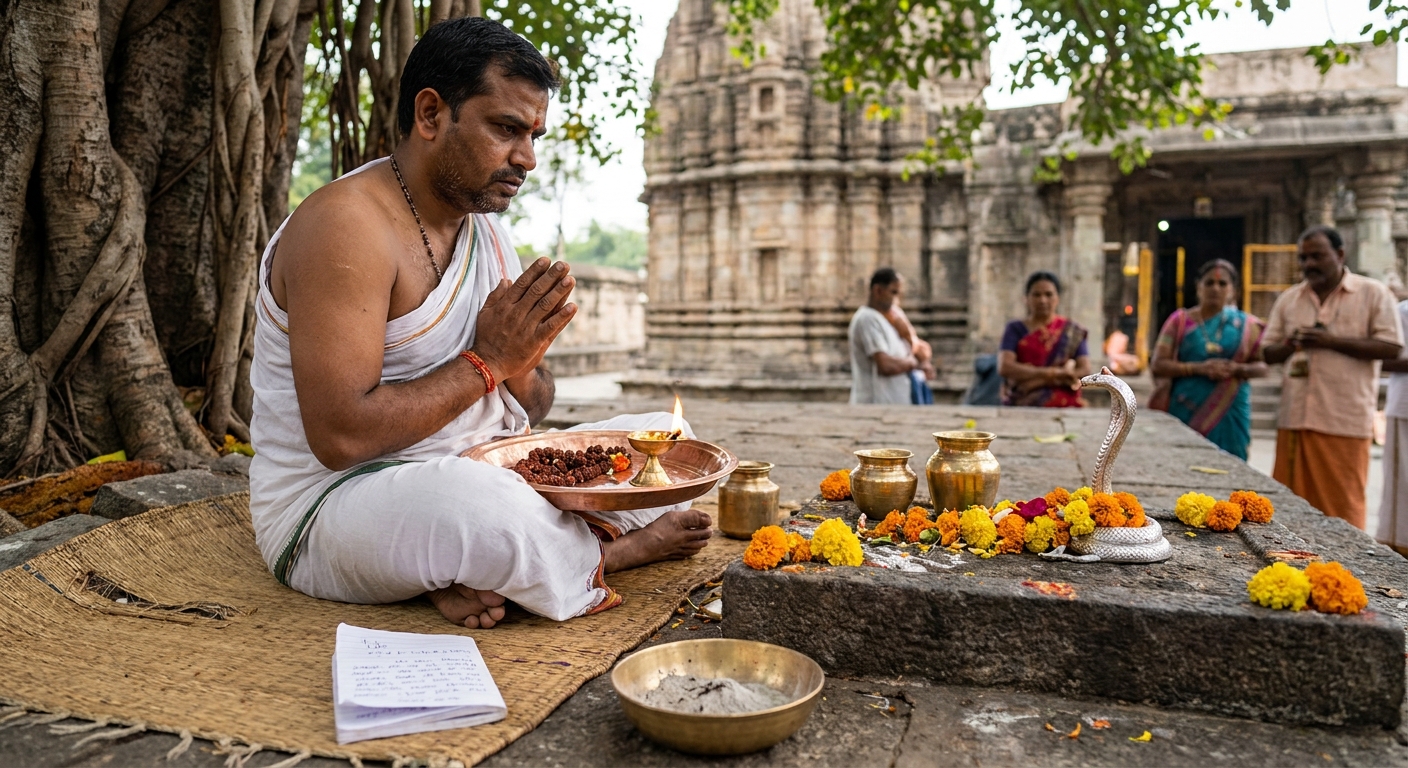
Kaal Sarp Dosha shows up in your kundli when all seven planets sit between Rahu and Ketu, hemmed in on one side of the lunar nodes axis, and it worries people more than almost any other dosha in Vedic astrology. This guide breaks down what it actually means, how to check for it, and which remedies astrologers actually recommend in 2026.
TL;DR
- Kaal Sarp Dosha forms when all planets fall between Rahu and Ketu in your birth chart, with 12 recognized types.
- Nag Panchami puja, done every year in Shravan month (July-August), is the most common remedy astrologers suggest.
- A Sarpa Dosha Nivarana Puja at Trimbakeshwar typically runs 3-4 hours and needs to be booked in advance.
- Not every planet-between-nodes pattern counts as full Kaal Sarp Dosha, so a professional chart reading matters before you spend on remedies.
- Wishastro lets you talk to an astrologer online to confirm the dosha type before choosing a remedy.
Why this matters
A lot of people get told they have Kaal Sarp Dosha based on a quick online chart generator, then panic-buy remedies without checking if the dosha is even complete. Partial placements, where one or two planets sit outside the Rahu-Ketu axis, don't count as full dosha and don't need the same remedies.
Getting this wrong wastes money on pujas you didn't need, or worse, leaves a real dosha unaddressed because someone assumed a partial chart was fine. The fix starts with an accurate reading, not a guess.
Wishastro's free tools let you generate your kundli and check planetary placements before you book a live consultation with an astrologer to confirm the dosha type and severity.
What you'll need
- Your accurate birth date, time, and place (time matters most here since Rahu-Ketu positions shift fast)
- A generated kundli or birth chart, either from a free tool or from an astrologer
- Basic knowledge of which of the 12 Kaal Sarp Dosha types applies to you (Anant, Kulik, Vasuki, Shankhpal, Padma, Mahapadma, Takshak, Karkotak, Shankhachur, Ghatak, Vishdhar, or Sheshnag)
- 30-45 minutes for an astrologer consultation if you want the reading confirmed
- Access to Nag Panchami-timed pujas if you plan a temple-based remedy in 2026
The steps
1. Generate an accurate kundli first
This is the step people skip, and it's the one that causes the most confusion. Use precise birth time down to the minute, because Rahu and Ketu move slowly through the chart, and a wrong time can shift whether a planet actually falls inside the axis.
Expected outcome: a chart showing exact placements of all nine grahas relative to Rahu and Ketu.
Common mistake: using an approximate birth time ("morning" or "around 6 AM") instead of the exact recorded time from a birth certificate or hospital record.
2. Confirm whether it's full or partial dosha
Full Kaal Sarp Dosha needs every single planet between Rahu and Ketu, with zero exceptions. If even one planet sits outside that axis, it's called a partial or Kaal Sarp-like formation, and most astrologers treat it far more lightly.
This distinction changes the remedy entirely. Full dosha usually calls for a dedicated puja; partial formations often just need a mantra practice or minor adjustments.
Common mistake: assuming any chart with Rahu and Ketu prominent is automatically full dosha.
3. Identify the specific type
Each of the 12 types (Anant through Sheshnag) is named for the position of Rahu relative to the ascendant and carries a slightly different life-area emphasis, from career and relationships to health and finances. Knowing the type helps an astrologer suggest a remedy suited to the actual pattern rather than a generic one.
Expected outcome: a specific label for your dosha type, which most kundli software or an astrologer can identify in under 15 minutes.
4. Chant the Maha Mrityunjaya Mantra daily
This is the most commonly recommended low-cost remedy. Astrologers typically suggest 108 repetitions daily, ideally during the Brahma Muhurta hours before sunrise, for a sustained period rather than a single session.
Why it matters: it's positioned as strengthening planetary resilience without requiring travel or a formal puja setup, and it works alongside any other remedy you choose.
Common mistake: chanting inconsistently for a few days and stopping, rather than sustaining the practice for weeks.
5. Perform Nag Panchami puja during Shravan month
Nag Panchami falls during Shravan month, which lands in July-August in 2026, and it's considered the most auspicious window for Kaal Sarp remedies tied to serpent deities. Offerings typically include milk, turmeric, and flowers to a Naag idol or image, done at home or at a temple.
Expected outcome: a completed ritual that most astrologers consider the baseline annual remedy for anyone carrying this dosha.
Common mistake: waiting until the day itself to plan, then rushing through offerings without proper preparation.
6. Book a Sarpa Dosha Nivarana Puja at a recognized temple
Trimbakeshwar in Maharashtra is the most referenced temple for this specific puja, and sessions there typically run 3-4 hours with a priest guiding the full ritual. This is the higher-commitment remedy people choose when the dosha is full and severe rather than partial.
Why it matters: these pujas follow a structured Vedic process that's harder to replicate accurately at home.
Common mistake: booking without checking the temple's current scheduling and required documentation in advance, since slots fill up around Nag Panchami and other auspicious dates in 2026.
7. Talk to an astrologer before committing to a paid remedy
Before spending on gemstones, pujas, or travel, get the chart read by someone qualified. A short consultation can confirm whether the dosha is even active in your current dasha period, since Kaal Sarp Dosha effects are often described as tied to specific planetary periods rather than constant.
You can talk to an astrologer online for free first to get a sense of whether a paid remedy makes sense for your chart.
Confirm your dosha before you spend
Talk to an astrologer online and check your chart first.
Troubleshooting
- Two different tools show different dosha status for the same chart. This almost always comes down to birth time accuracy. Re-verify the exact time and re-generate the chart before trusting either result.
- You did Nag Panchami puja last year but still feel unlucky. Remedies are described as reducing intensity over a dasha period, not eliminating a life pattern instantly. Sustained practice matters more than a single ritual.
- An astrologer says you have partial dosha but a website said full. Free online generators often flag any Rahu-Ketu prominence loosely. A human reading of the exact chart is more reliable for this specific distinction.
- You can't travel to Trimbakeshwar or another temple. Home-based Nag Panchami offerings and the Maha Mrityunjaya Mantra practice are considered valid alternatives by most astrologers when travel isn't possible.
- You're not sure which of the 12 types applies to you. This needs a proper chart reading rather than guesswork, since the type depends on exact ascendant and Rahu placement.
Tools and resources
- A free kundli generator to check exact planetary placements before assuming dosha status
- Kundli matching using just your date of birth if you're also checking compatibility alongside a dosha reading
- A panchang or calendar to track the Shravan month window for Nag Panchami in 2026
- A qualified astrologer for a paid consultation if the free chart check flags full dosha
What to do next
Once you know your dosha type and have started a remedy, the next practical step is checking how it interacts with other chart factors, especially if marriage or partnership timing is part of your concern. Kundli matching is a useful next check in 2026, since Kaal Sarp Dosha in one partner's chart is often weighed against compatibility factors before big decisions.
One last thing
The detail most people miss: partial Kaal Sarp Dosha, where even one planet sits outside the Rahu-Ketu axis, is far more common than full dosha, yet it gets treated with the same panic online. Before you book any puja for 2026, get the exact placement confirmed. It's the single check that decides whether you need a temple visit or just a daily mantra practice.