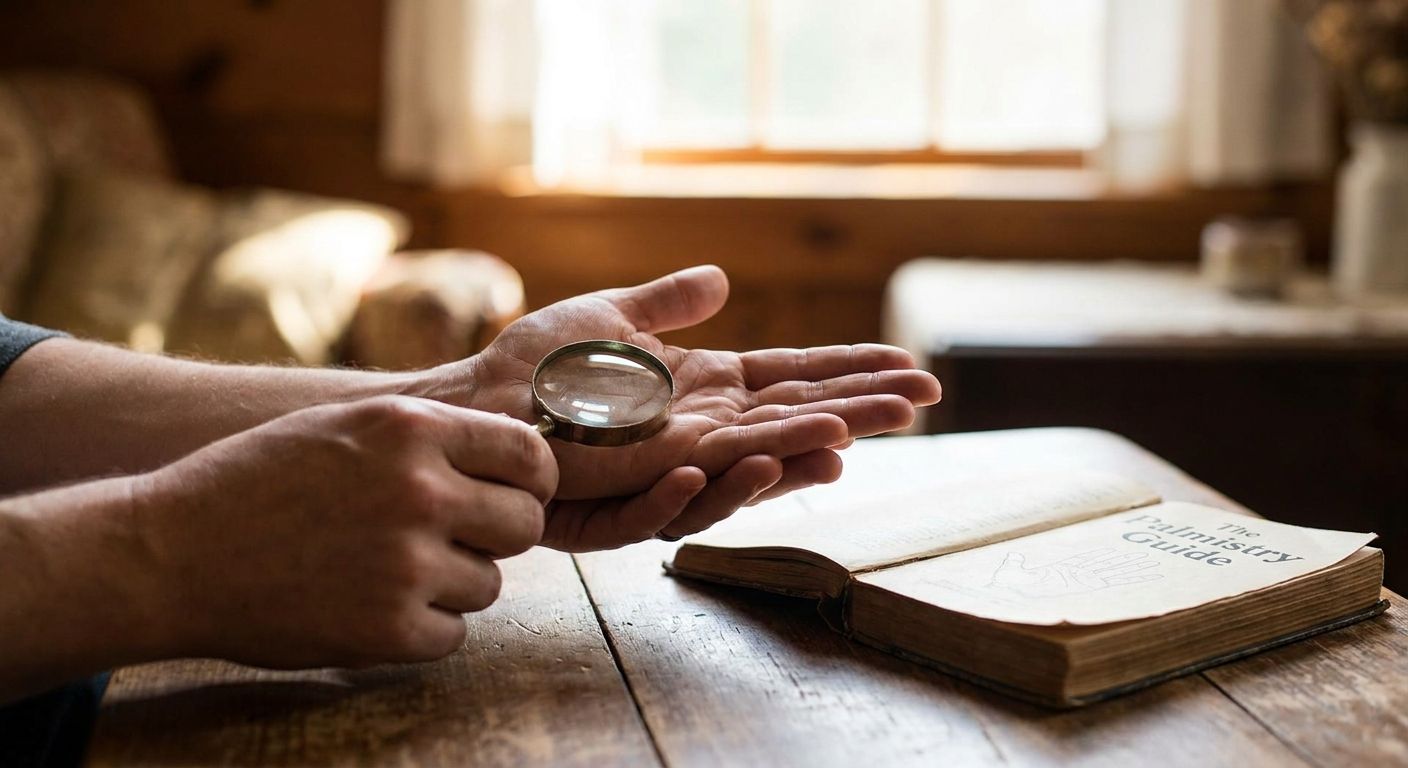
The line popularly called the marriage line sits on the outer edge of the palm, below the little finger and above the heart line. Palmists may call it a union line, relationship line, affection line or vivah rekha. There is no scientific evidence that its shape predicts marriage, compatibility or divorce.
This article is for guidance and reflection, not a substitute for professional relationship, mental health or legal advice. Do not use a palm line to decide whether to marry, remain in a relationship or separate.
TL;DR
- Palmists usually look for short horizontal lines on the outer edge of the hand below the little finger and above the heart line.
- The marriage line is also called a union, relationship, affection or vivah line; names and meanings differ across schools.
- One line does not mean one marriage, and several lines do not count future spouses.
- Forks, breaks and islands have traditional meanings, but they cannot predict separation or divorce.
- Use palmistry for reflection, not to decide whether to marry, stay or leave.
Why the name can mislead
Marriage line palm reading is a common search term, but many palmists prefer union or relationship line because the marks are not treated as a literal marriage count. Interpretations also change between Indian and Western schools and between individual practitioners.
Indian palmistry is often discussed under names such as Hasta Samudrika, Samudrika Shastra or Hast Rekha Shastra. Those traditions may be practiced alongside Jyotish, but a palm is not a kundli and the two methods use different inputs. If you want to inspect the whole hand rather than one crease, Wishastro's Palm Reading tool accepts photos of both palms.
How to locate the relationship lines
1. Look at the side of the hand
Turn the palm toward you and inspect the outer edge directly below the little finger. The short horizontal creases in this band are the lines usually discussed. They can be easier to see from the side than from a straight-on photograph.
2. Find the heart line first
The heart line is a larger crease that starts near the little-finger side and travels across the upper palm. The shorter relationship lines sit above it, closer to the base of the little finger. Do not mistake a fine branch of the heart line for a separate union line.
3. Use soft side light
Relax the hand instead of stretching the skin tight. Light from the side casts a small shadow in each crease and makes faint lines easier to distinguish. A phone photograph can help, but sharpening filters may create edges that are not present on the hand.
4. Note what is actually visible
Record the number of prominent lines, their length, depth and direction. Ignore very fine surface creases at first. There is no universal cutoff that turns a crease into a marriage line, so compare the marks relative to each other rather than measuring millimeters as destiny.
How palmists traditionally read the marks
A single prominent line
Some schools read one clear line as a strong focus on one significant partnership. It does not prove that a person will marry once. A hand can have one prominent crease regardless of someone's relationship history.
Several lines
Several noticeable lines may be read as more than one important attachment or as different phases in a person's approach to partnership. They are not a spouse counter. Fine lines can also come from ordinary skin folding, which makes exact counts unreliable.
An upward or downward slope
An upward line is sometimes given an optimistic reading, while a line that slopes toward the heart line may receive a more difficult one. These are conventions, not observed relationship outcomes, and meanings vary across books and readers.
Forks, islands and breaks
A fork means the line divides; an island looks like a small enclosed loop; a break is a visible gap. Palmists attach themes such as distance, divided priorities or disruption to these shapes. None of them establishes that a relationship will fail, and a broken line does not diagnose or predict divorce.
Which hand should you read?
Compare both hands if you want to follow a common palmistry method. Some readers treat the dominant hand as present choices and the non-dominant hand as inherited tendencies. Other schools use different rules, including left-right conventions based on gender. That disagreement is a good reason not to present either hand as the factual record of a relationship.
Photograph both palms under the same light and angle. A difference may give a palmist more material to interpret, but it does not prove that your past changed a line or that a future event is approaching.
Read the whole hand, not one crease
Palmists may compare the relationship lines with the heart line, Mount of Venus, hand shape and finger proportions. Even within palmistry, a verdict based on one small mark is weak practice. Outside the tradition, there is no validated method that converts those features into a relationship forecast.
Kundli matching is a separate astrological method based on two birth charts. If that is the tradition you want to explore, use the Kundli Matching tool. Neither a matching score nor a palm line should overrule consent, safety, communication or what you know about the relationship itself.
Relationship decisions need real evidence
Look at how you handle conflict, money, family boundaries, affection and plans for the future. If you feel unsafe, seek help from a trusted person or an appropriate local service. A counselor can help with communication and recurring conflict; a lawyer can explain legal rights during separation. Palmistry cannot do either job.
Want a fuller palm reading?
Upload clear photos of both palms and compare the relationship line with the rest of the hand.