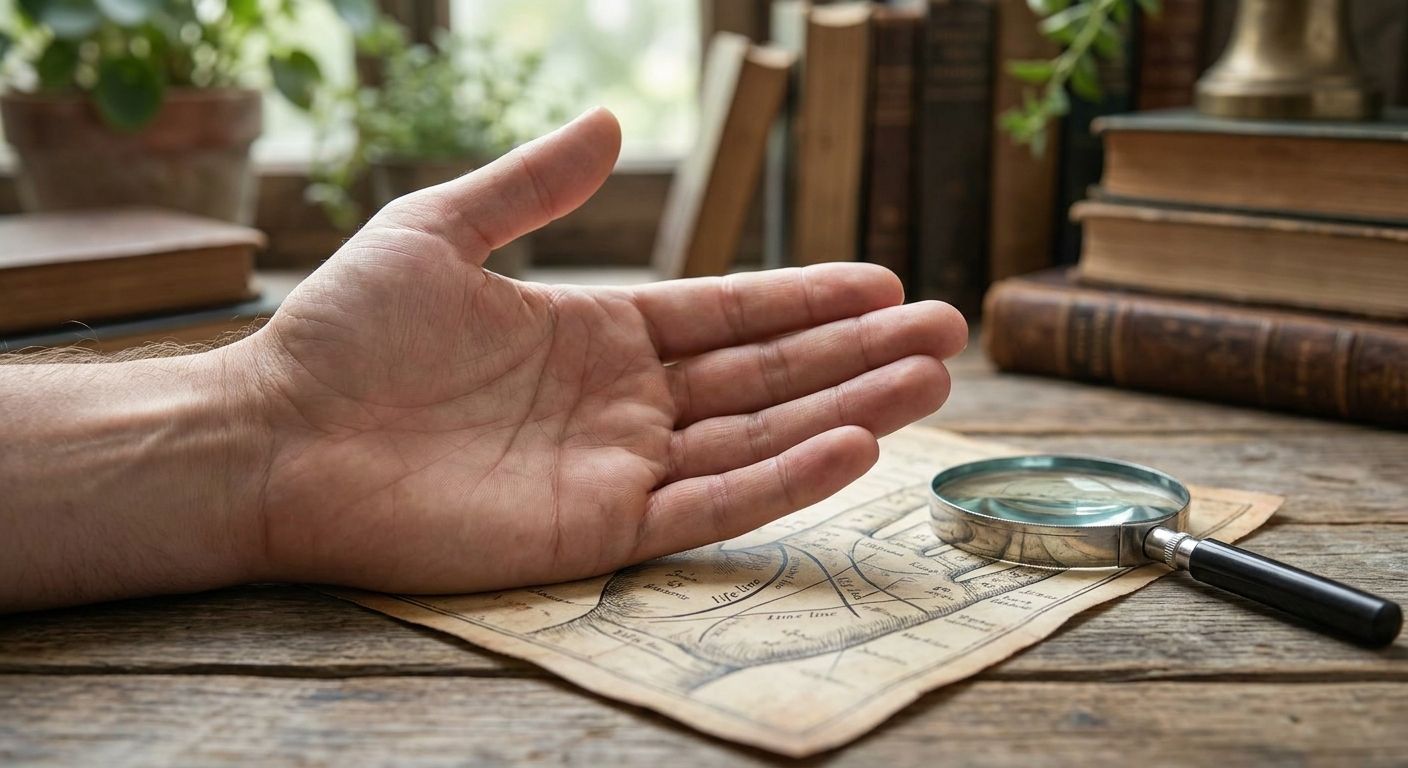
Your life line's length says nothing about how long you'll live. In hasta samudrika shastra, the Vedic system behind palm reading, the line is read for vitality, how fast you recover from illness and how much reserve energy you're carrying, not for a countdown of years. The break or chain that alarms most first-time readers gets read as a season of low energy or a major life shift, never as a diagnosis, and definitely never as a date.
TL;DR
- Life line palm reading reads length for vitality and recovery, never for years lived.
- A break reads as a major life shift or illness episode, not death, especially with a line picking up nearby.
- Chains and islands read as temporary dips in immunity or stress, not permanent damage.
- A faint, short or missing life line is read against the head and heart lines, never alone.
- Wishastro's astrologers read the life line alongside your kundli when you want a fuller picture in 2026.
Why this matters
Palm reading has no controlled study tying a crease in your skin to a number of years you'll live, and no serious palmist claims one exists. What hasta samudrika shastra actually offers on Wishastro is a structured way to read your baseline vitality and stress pattern, the same question a lagna chart answers from a birth time angle instead of a palm crease. In 2026, that's still the honest frame for this line: a pattern to notice, not a sentence to fear.
The line rewards a slow, specific look rather than a glance. Length, depth, breaks, chains and where it starts and ends each carry their own reading, and none of them work in isolation from the other two major lines on your palm, the head line and the heart line.
How to read your life line for health and longevity
Work through your palm in this order. Use good light and your non-dominant hand first.
- Find the line. It starts near the edge of your palm between your thumb and index finger, on the Mount of Jupiter, then curves down and around the fleshy Mount of Venus toward your wrist.
- Read the length, then set it aside. Traditional palmistry ties length to stamina, not years lived. A short line paired with a strong heart line often reads as someone who burns energy fast but recovers fast too; palmists in 2026 still read length this way, the same as texts centuries older.
- Check depth and clarity. A deep, unbroken line reads as a constitution that handles stress well. A faint, wavering line reads as inconsistent energy, someone who needs more rest than they usually admit to needing.
- Look for breaks. A clean break reads as a major shift, illness, a move, a career change, that interrupts your usual rhythm. If a new segment picks up close to the break, the tradition reads that as recovery, not decline.
- Spot chains and islands. A chained stretch, small linked loops instead of a clean run, reads as a period of low immunity or grinding stress. A single island reads as a temporary dip, usually tied to one identifiable event rather than an ongoing pattern.
- Note the ending. A line that forks upward near the wrist reads as vigor returning later in life. One that droops toward the base of the thumb reads as a tendency toward fatigue worth managing actively rather than one that just happens to you.
Broken life line: what it means
A broken life line is read as a disruption, not an ending: illness, a major move, a job loss, anything that knocks your usual rhythm off course. What decides how the tradition reads it is what happens around the break, not the break itself. A clean overlap, where a new segment picks up just past the gap, reads as recovery and continuation. A break with no overlap and a faint segment after it reads as an ongoing rebuild, one where pacing yourself matters more than pushing through.
Chained life line: what it means
A chained life line, where the line splits into small linked loops instead of running clean, is read as a season of low immunity or grinding stress rather than a single crisis. It shows up most often across the first third of the line's run, roughly the stretch that corresponds to early adulthood. Palmists read a chain as a signal to slow down, not as a fixed sentence, since the line often clears into a single strong stroke further along its path.
Double life line (sister line): what it means
A second, fainter line running parallel to the main life line, sometimes called a sister line, is read as extra resilience: a backup reserve that kicks in during the exact stretches the main line looks weak, broken or chained. It's one of the more reassuring marks in hasta samudrika shastra, read as protection rather than duplication. Not everyone has one, and its absence on your palm means nothing on its own.
Faint or short life line: what it means
A faint or noticeably short life line is read for low baseline energy or a cautious relationship with physical risk, not for a shortened lifespan; this is the single most misread mark in popular palmistry. What actually moves the reading is the heart line and head line beside it. A short life line next to a strong, deep heart line reads very differently from a short life line next to a faint head line, and read alone, a short line tells you almost nothing.
Why life line readings vary
- Which hand you read. In most schools the non-dominant hand is read for what you were born with, the dominant hand for what you've built since; the same person's life line can look genuinely different on each.
- Which lines it's read against. A life line never stands alone. Palmists read it next to the head line for mental stamina and the heart line for emotional reserve before saying anything about vitality.
- Which system is doing the reading. Hasta samudrika shastra and Western chiromancy assign slightly different weight to length versus depth, so a line read as strong in one can read as merely average in the other.
- How the line gets combined with your chart. Some readers pair a palm reading with a birth chart detail like your lagna, since both are read as questions about baseline constitution from different inputs.
- The palmist's own experience. Two trained readers can genuinely disagree on where a chain ends and a break begins, and that isn't a flaw unique to palmistry; it's true of any discipline built on pattern recognition rather than measurement.
Does a short life line mean a short life?
A short life line does not mean a short life; it's the most common misreading in popular palmistry, and it has no basis even inside the tradition that produced the line. Hasta samudrika shastra reads length for stamina and how much energy you draw on day to day, so a short line next to a strong heart line often belongs to someone who lives a long, active life on a different energy budget than someone carrying a long line.
Can your life line change over time?
Yes, and palmists treat this as normal rather than alarming: the skin's crease pattern shifts slightly with age, injury and sustained stress, so a line read at twenty-five can look different by forty. What tends to stay stable is the line's overall shape and starting point. What changes is depth, clarity and the appearance of chains, islands or a second sister line as life adds its wear.
Which hand should you read, left or right?
Read your non-dominant hand for what you were born with and your dominant hand for what you've shaped since, the standard split most palmists use regardless of school. If the two hands tell noticeably different stories, that gap is itself read as meaningful, usually meaning you've actively worked against or reinforced whatever your non-dominant hand shows. A trained reader looking at both hands together, in a proper conversation with an astrologer, reads that gap more precisely than any guide can from a photo.
One last thing
The mark most people ask about, a dramatic break mid-line, is also the one palmists worry about least. What actually changes a reading's weight is a faint, wavering line with no clear start or end point near the Mount of Jupiter: it's harder to read precisely because it gives the palmist less to work with, not because less is going on for you. If your life line has always looked indistinct rather than dramatic, that's a better reason to get an actual pair of trained eyes on your palm in 2026 than any sharp-looking break ever is.
This article is for guidance and reflection. It is not a substitute for medical advice, diagnosis, or treatment.