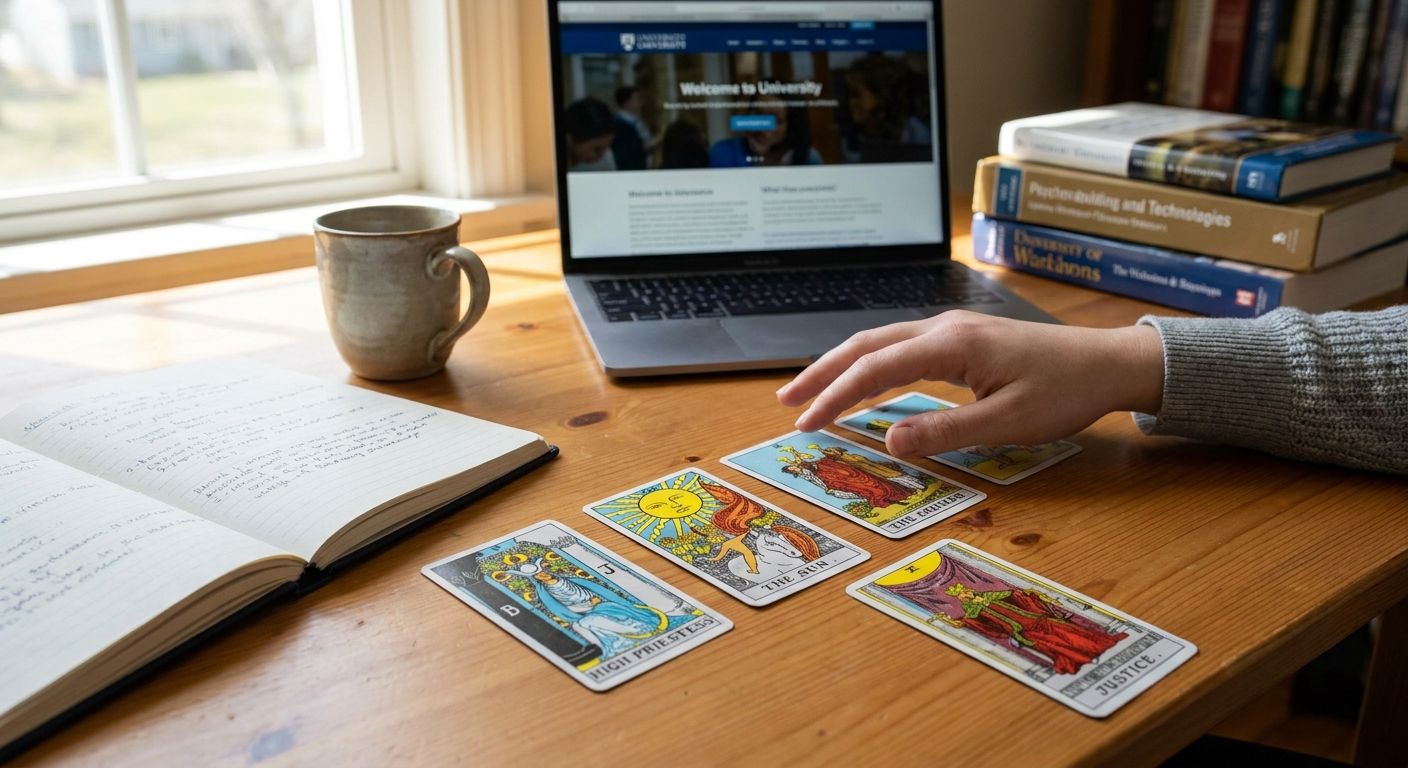
A tarot reading for exam results works best as a three-card spread that covers preparation, the hidden obstacle, and the likely outcome of your effort, not a yes-or-no pass or fail. In 2026 the cleanest method is one clear question, a full shuffle of the 78-card deck, and a read that treats Swords as mental load and Pentacles as the grade you can still shape.
TL;DR
- Three-card spread wins for exam questions in 2026: prep, obstacle, outcome.
- Ask about effort and approach, never force a pass or fail verdict.
- Swords track study stress; Pentacles track concrete marks and work.
- Major Arcana name the big theme; minors name the daily grind.
- Wishastro suits a quick free self-reading before you go deeper.
Why this matters
Exam season compresses months of work into a few sittings, which is why so many students reach for a deck the week before a paper. Tarot will not rewrite a marksheet. What it can do is show where energy leaks, which fear is driving the revision plan, and whether the next stretch favours steady grind or a sharp change of method.
That is the gap between a party trick and a reading you can act on. A structured tarot reading for exam results gives you a map of what is still movable before results day, and what is already set by the work you have done.
How to do a tarot reading for exam results
The 2026 method in one line: write one honest question, shuffle a full 78-card deck until it settles, lay three cards left to right for preparation, obstacle, and outcome, then read suit and rank before you invent a story.
Step 1: Write a question the cards can answer
Skip "Will I pass?" That question begs a binary the deck rarely delivers cleanly, and it freezes you instead of steering you. Better shapes in 2026:
- What is the strongest support in my preparation right now?
- Where is fear distorting how I revise this subject?
- What approach gives this paper the best chance I can still earn?
A good exam question names the paper or subject, stays in the present or near future, and leaves room for action. If you cannot change anything the answer points at, rewrite the question.
Step 2: Set the space and shuffle
Sit where you will not be interrupted for ten minutes. Phone face down. Hold the question in plain words, not a wish. Shuffle until a cut or a card that sticks feels natural; there is no magic number of shuffles, only the point where your hands stop fidgeting.
Use a full deck (22 Major Arcana plus 56 Minors). Pulling only Majors makes every exam sound like a life crisis. You want the daily texture of Swords and Pentacles in the mix.
Step 3: Lay a three-card exam spread
Left to right:
- Preparation: how you have built the attempt so far.
- Obstacle: the block, bias, or leak that still costs marks.
- Outcome of effort: the direction your current path is heading, not a sealed grade.
Read position first, card second. The same Tower in position 1 is not the same Tower in position 3.
Step 4: Read suit and rank before the story
Swords speak to mind, argument, and exam anxiety. A heavy Swords line often means overthinking or harsh self-talk more than weak content.
Pentacles speak to work done, time invested, and tangible results. They are the suit closest to marks, practical revision, and stamina.
Wands speak to drive and burnout risk. Cups speak to morale and whether emotion is helping or flooding the desk.
Major Arcana name the chapter you are in. The Hermit favours deep, quiet study. Justice favours fair outcomes tied to what you actually submitted. The Star favours recovery after a rough mock. The Tower favours a sudden break in method or timetable that you either ride or resist at cost.
Court cards often show a stance you are taking (or avoiding): a Knight of Swords rushing the paper, a Queen of Pentacles pacing the work, a Page still collecting basics.
Step 5: Close the reading with one action
Write one sentence that starts with a verb: "Redo the weak chapter with timed questions," "Sleep before another past paper," "Ask the teacher about the marking scheme on X." If the reading ends only in mood, you have not finished it.
- Single card
Cards: 1
Best for: One narrow worry the same day
Verdict: Hold - Three-card (prep / obstacle / outcome)
Cards: 3
Best for: Most exam questions in 2026
Verdict: Use this - Five-card (add advice + timing)
Cards: 5
Best for: When the three-card feels thin
Verdict: Hold - Celtic Cross
Cards: 10
Best for: Full life context, not a single paper
Verdict: Skip before a paper
Best for most students sitting board or university papers: the three-card line. It is short enough to stay honest and wide enough to show a leak you can fix.
Cards that often surface around exams
These are tendencies in the Rider-Waite-Smith tradition and decks built on it, not promises.
- Ace of Pentacles: a real opening to bank marks through practical work; best read as start the concrete task today.
- Eight of Pentacles: craft through repetition; strong for drill, weak if you only reread notes.
- Nine of Swords: night anxiety that inflates the paper; the card rarely says you lack knowledge.
- Three of Swords: a sharp disappointment already in play, or fear of one; check whether you are studying the wound instead of the syllabus.
- Justice: outcome tied to what was earned; poor card for shortcuts, strong card for clean process.
- The Hermit: solo deep work beats group panic; best for the final stretch of a hard subject.
- The Star: recovery after a bad mock or a harsh term; morale card with a work demand still attached.
- Seven of Wands: defend your method under pressure; useful when comparison with classmates is eating time.
Honest limit: a "good" card does not cancel unstudied chapters. A "hard" card does not erase months of solid work. Tarot names the weather around the attempt; you still sit the paper.
Why a tarot reading for exam results varies
- Question wording. "Will I pass?" collapses nuance. "What blocks my Physics paper?" opens a usable answer.
- Deck language. Rider-Waite-Smith imagery is the common baseline in 2026. Oracular or pip-only decks need a firmer suit system or the read goes vague.
- Your state while shuffling. Reading at 2 a.m. after a panic scroll loads the draw with noise. A calmer pass the next morning often clarifies the same theme.
- Timing relative to the exam. Two weeks out, obstacle cards point at fixable gaps. The night before, they more often name mindset and sleep.
- Whether you want guidance or reassurance. If you only accept pass-coded cards, you will force the story and miss the leak the deck actually showed.
- Skill with reversals. If you do not read reversals cleanly, keep the deck upright for exam work so you are not stacking doubt on doubt.
Can tarot predict if I will pass my exam?
No responsible tarot reading for exam results in 2026 should sell a sealed pass or fail. The cards describe the pattern around your effort, stress, and method; the mark still comes from what you write in the hall. Use the draw to change preparation, not to outsource the grade.
Which tarot cards suggest stronger exam ground?
Pentacles Aces through Nines, Justice, the Hermit, and steady Court Pentacles often support a work-backed attempt. Heavy Swords without grounding Pentacles more often flag anxiety management as the real homework. Read the whole line, not one trophy card.
Should I pull cards the night before the paper?
Only if the question is about calm, sleep, or last-day focus. A full outcome spread the night before tends to feed rumination. In 2026 the sharper move is a one-card focus pull ("What does tomorrow's attempt need from me?") and lights out.
Students who also track timing in a Vedic frame sometimes pair a card pull with chart work; how to calculate your lagna without exact birth time is a practical entry when birth time is messy. Keep the two methods honest: cards for the immediate story, lagna for broader structure, not as double confirmation theatre.
If a spread stays muddy after two calm passes and you want a second pair of eyes, talking to an astrologer online is one way to set the tarot beside a fuller reading. Use that once you already know what the cards said, so you are not shopping for a kinder story.
Run a calm self-reading
Open Wishastro, pull a spread, and write one action from the cards.
Pros and cons of using tarot for exams
Pros
- Fast external mirror when your own thoughts loop.
- Names leaks (sleep, panic, shallow revision) you can still fix.
- Costs nothing but attention when you read for yourself.
Cons
- Easy to twist into fortune-telling you then obey or fear.
- Poor substitute for past papers and marking schemes.
- Night-before full spreads often raise arousal instead of focus.
Best for: students who will end the reading with one concrete study action. Skip if: you only want a guarantee, or you already spiral after every "negative" card.
Quotable verdict: A tarot reading for exam results is best for students who want a clear map of effort and obstacles, not a promise of the mark.
Wishastro keeps tarot in the same toolkit as kundli and other free chart tools, so you can run a self-reading when you want the cards alone, without turning the night into a performance.
One last thing
The most useful exam card is often the dull one. Eight of Pentacles will not flatter you. It will tell you to drill the weak unit again while everyone else rereads highlighted notes and calls it revision. In 2026, treat that kind of card as a gift: boring, specific, and still inside your control the morning before the paper.