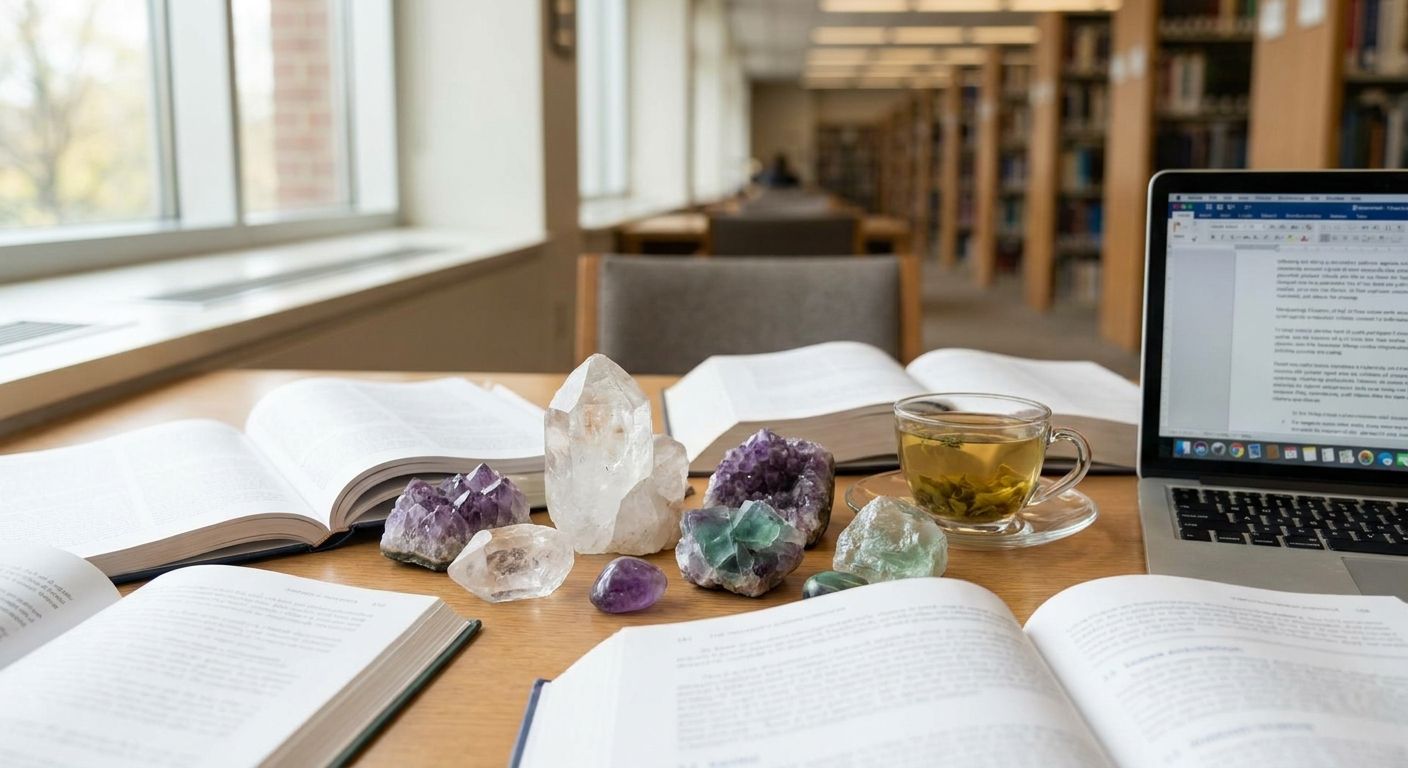
Gemstones for students are often marketed with promises about focus, memory and exam scores. Those promises go beyond the evidence. Jyotish does have traditional planet-gem associations, but they should be described as beliefs and symbols, not as treatments or study aids with predictable results.
This article is for guidance and reflection, not a substitute for professional educational or medical advice. Gemstones have not been shown to improve focus, memory, anxiety or exam results.
TL;DR
- No gemstone has been shown to improve memory, focus, anxiety or exam results.
- Jyotish traditionally links Emerald with Mercury, Yellow Sapphire with Jupiter and Pearl with the Moon.
- Diamond is the classical Venus gem; some later lists use White Sapphire, while Moonstone belongs with the Moon.
- There is no evidence-based gemstone dose or body-weight formula.
- Treat a gem as a cultural or personal symbol, not a replacement for study support or healthcare.
What the tradition says
Classical navaratna practice assigns a principal gem to each graha. In education-focused readings, practitioners may discuss Mercury, Jupiter or the Moon because Jyotish literature connects those planets with communication, learning and the mind. That interpretive link is not evidence that wearing the related stone changes cognition.
Gemstone | Traditional planet | Traditional theme |
|---|---|---|
Emerald | Mercury | Communication and analysis |
Yellow Sapphire | Jupiter | Learning and wisdom |
Pearl | Moon | Mind and emotion |
Diamond | Venus | Art, pleasure and aesthetics |
Blue Sapphire | Saturn | Discipline and endurance |
Cat's Eye | Ketu | Detachment and inward focus |
Diamond is the classical navaratna for Venus. Some later planetary-gem lists use White Sapphire as a secondary Venus stone. Moonstone belongs with the Moon, not Venus, so it should not be grouped with White Sapphire as a Venus substitute.
Fixing a common nakshatra example
Nakshatra is a finer division than rashi, but examples still need to respect the zodiac. Rohini lies in Taurus and Ashlesha lies in Cancer, so they are not two nakshatras within the same rashi. Pushya and Ashlesha both lie within Cancer and are a correct comparison.
This distinction matters when someone uses a detailed chart to justify a sale. Check the underlying placement with a birth chart tool, and ask the practitioner to explain the method without turning an interpretation into a guaranteed outcome.
What the evidence does not support
There is no reliable evidence that Emerald improves verbal recall, Yellow Sapphire speeds comprehension, Pearl calms exam anxiety, or Blue Sapphire builds discipline. There is also no evidence-based ratti or carat dose tied to a student's body weight.
Sleep disruption, mood changes and a difficult exam week are not valid tests of whether a stone "matches" a chart. Those experiences can have ordinary causes that deserve ordinary attention. If concentration problems are persistent or interfere with daily life, speak with a qualified health or educational professional.
A sensible way to approach a traditional gemstone
Decide what role the stone is actually playing
A student may wear a family gemstone as jewellery, a cultural practice or a reminder of an intention. That is different from expecting the stone to deliver a grade. Naming the role keeps the purchase honest.
Check identity and treatments
For an expensive gem, ask for an independent laboratory report. It may identify whether the stone is natural or laboratory-grown and disclose detectable treatments. It does not certify benefits for memory, focus or wellbeing.
Protect the study plan first
Before spending heavily, put money and attention into the things that directly support learning: a realistic timetable, practice under exam conditions, tutoring when needed, sleep, and an evaluation for persistent attention or anxiety concerns.
Keep ritual instructions in their proper category
Metal, finger, weekday and trial instructions vary by lineage. They are ritual customs, not educational or medical safety standards. Ordinary jewellery safety still applies, especially secure settings and metals that do not irritate the skin.
What to avoid
- Promises of a specific score, memory gain or result timeline.
- Body-weight formulas presented as gemstone dosing.
- Claims that poor sleep or a low grade proves the stone is wrong.
- Treating Moonstone as a Venus gem.
- Spending money needed for tutoring, books, healthcare or exam fees.
A clearer comparison
Question | What can be said safely |
|---|---|
Which stone is linked to Mercury? | Emerald in the classical navaratna list |
Which stone is linked to Jupiter? | Yellow Sapphire in the classical list |
Which stone is linked to the Moon? | Pearl, with Moonstone appearing in some later lists |
Will a stone improve memory? | No reliable evidence supports that claim |
How many carats should a student wear? | There is no evidence-based dose |
One last thing
A gemstone should never become another source of pressure before an exam. If it carries family meaning or helps mark an intention, that can be enough. The student's result still belongs to preparation, support, circumstances and health, not to a stone.