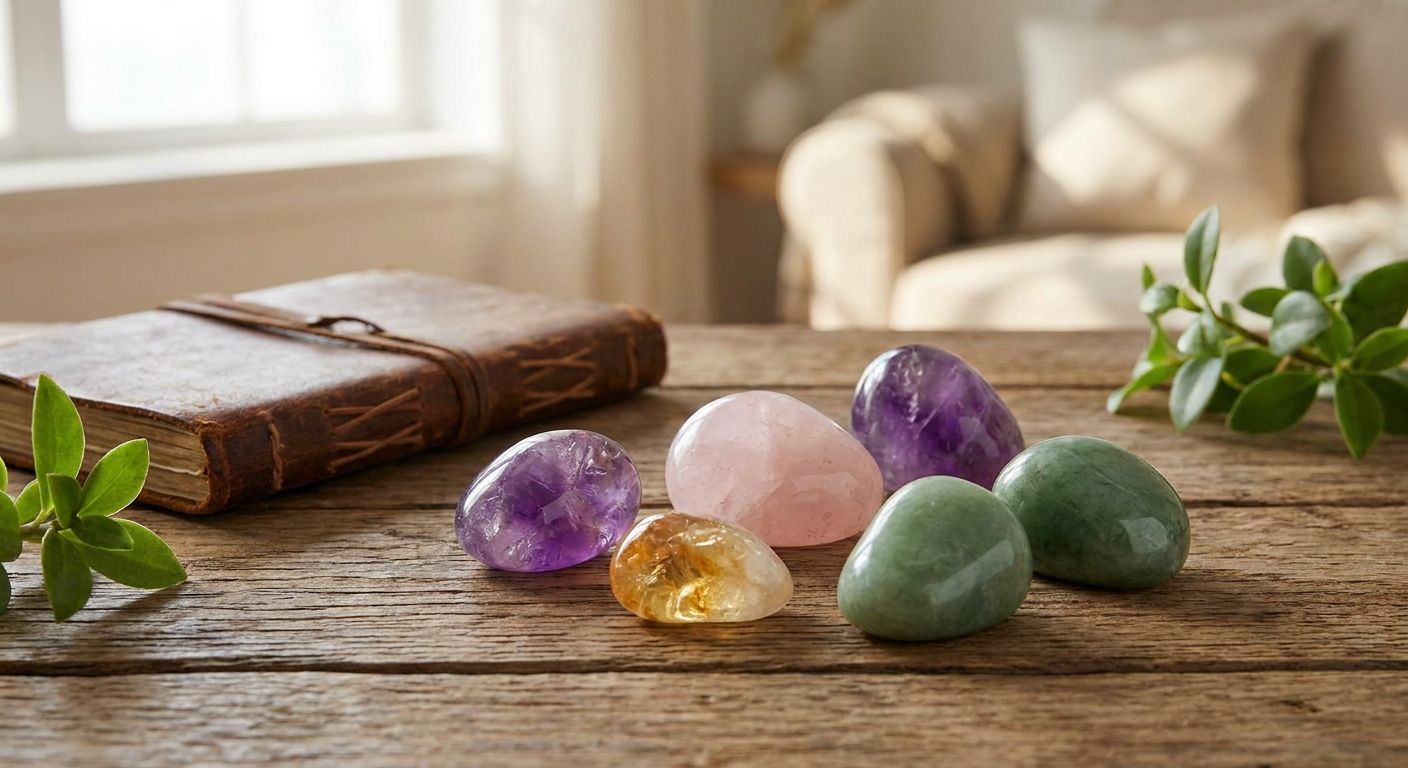
Rashi gemstone lists connect each Moon sign with its ruling planet and that planet's traditional gem. They can explain a Jyotish custom, but they cannot tell you which stone will improve health or vitality. No gemstone is a medical treatment, and the traditional associations have not been shown to produce health outcomes.
This article is for guidance and reflection, not a substitute for professional medical advice, diagnosis or treatment. Gemstone health effects belong to tradition and are not established by clinical evidence.
TL;DR
- Jyotish links rashis, planets and gemstones as a traditional practice, not as medical treatment.
- A rashi is a 30-degree Moon sign, but practitioners may also consider lagna and the full chart.
- Blue Sapphire is linked to Saturn. Hessonite is linked to Rahu and is not a Saturn substitute.
- A gem report can identify a stone and disclose detectable treatments, but it cannot certify an astrological effect.
- There is no evidence-based carat dose or symptom-based trial for health or vitality.
Rashi is only one part of the traditional method
A rashi is the 30-degree sidereal sign occupied by the Moon at birth. A simple list maps that sign to its ruling planet and then to the planet's navaratna. Practitioners may also consider lagna, house rulership, dignity, aspects and dasha. Those methods vary, which is why a rashi-only list should be described as a starting map rather than a prescription.
Western birthstone lists usually follow calendar month or tropical Sun sign. They do not use the same planetary logic. The difference explains why the lists disagree; it does not make either one a health intervention.
Five common rashi and gemstone associations
Mesha (Aries): Red Coral and Mars
Mars rules Mesha, and Red Coral is Mars's classical navaratna. Traditional texts and practitioners attach themes such as drive and courage to Mars. That symbolism should not be converted into claims about blood, stamina or immunity.
Vrishabha (Taurus): Diamond and Venus
Venus rules Vrishabha, and Diamond is Venus's classical gem. Some later lists offer White Sapphire as a less expensive Venus stone. Neither choice has been shown to affect skin, fertility, stress or general health.
Simha (Leo): Ruby and the Sun
The Sun rules Simha, and Ruby is the traditional solar gem. Astrological language about vitality is symbolic and interpretive. It is not evidence that Ruby strengthens immunity or treats fatigue.
Kanya (Virgo): Emerald and Mercury
Mercury rules Kanya, and Emerald is Mercury's classical gem. Claims about digestion, nerves or concentration go beyond what a gemstone can be shown to do. Persistent symptoms need appropriate clinical assessment.
Makara (Capricorn): Blue Sapphire and Saturn
Saturn rules Makara, and Blue Sapphire is Saturn's classical navaratna. Hessonite belongs to Rahu, not Saturn, so it should not be listed as a gentler substitute for Blue Sapphire. Amethyst appears in some modern substitute lists, but it is not a universal classical replacement.
What a gem report can actually verify
A reputable laboratory report can identify the gem species or variety, state whether it is natural or laboratory-grown, and disclose treatments the laboratory can detect. It does not certify that a natural stone carries an astrological effect, and it does not prove that a treated or synthetic stone lacks one. Those are belief claims outside gemological testing.
Use a report to understand what you are buying. Also check the report number, return policy, setting quality and seller disclosures. A higher price, larger carat weight or "untreated" label is not evidence of a health benefit.
Trials, rituals and physical safety
Some practitioners recommend trial wear for Blue Sapphire or other stones. That is a lineage-dependent custom, not a universal rule and not a validated safety test. Restlessness, poor sleep or conflict should not be used to diagnose whether a gemstone suits a chart.
Metal, finger and weekday instructions also vary. If you choose to follow them, treat them as ritual details. For physical safety, use a secure setting, avoid metals that trigger an allergy, and stop wearing jewellery that irritates the skin.
What to avoid
- Treating a gemstone as a remedy for a diagnosed condition.
- Linking Mars to blood, Venus to reproductive health, Mercury to digestion, or Saturn to chronic illness as if those were medical findings.
- Calling Hessonite a Saturn substitute. It is traditionally linked to Rahu.
- Treating a laboratory report as proof of astrological efficacy.
- Following a body-weight or carat formula as though it were a dose.
- Using changes in sleep, mood or symptoms as a gemstone fit test.
A practical decision check
Question | Useful answer |
|---|---|
What does the rashi list show? | A traditional Moon-sign and planetary correspondence |
What does the full chart add? | More factors within the practitioner's interpretive method |
What does a lab report show? | Identity, natural or laboratory-grown origin, and detectable treatments |
What does it not show? | Astrological efficacy or a health benefit |
When should I see a clinician? | For symptoms, diagnosis, treatment or changes to existing care |
One last thing
You do not have to dismiss a family or religious custom to describe its limits honestly. A gemstone can hold cultural meaning, mark an intention or be worn as jewellery. That is different from claiming it changes the course of an illness or supplies measurable vitality.